The One-Body Problem
Forces
Consider a human being, who possesses at a point in time various desires, impulses, and habits—various “forces”—each which, if taken in isolation, would incline them towards some actions; towards some “movement” in some “vector” or direction in the space of possible actions.
Likely these forces conflict with each other: hunger suggests they eat now, but work demands their immediate attention; perhaps they have in mind something they’d like to say to someone, but at the same time desire to not make a scene; perhaps they’d like to quit their job but for various reasons cannot. Our imagined person may not even be aware of all the forces motivating them, or of the fact they are in conflict; certainly we have all had the experience of being agitated by hunger without realizing it, say, or that we might be discontent in a job or relationship well before we allow ourselves to consider quitting it.
Schematically we get something like a force diagram in physics:
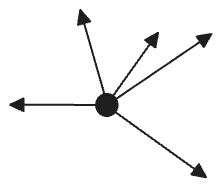
This analogy can be followed a bit: person under the influence of many contradictory forces is likely to experience a “decision paralysis”; the vectors of their desires cancel each other and render overall action impossible.
But unlike simple physical forces, we cannot sensibly “add” these desires to determine some net direction of motion.
How then is it then determined, given a number of conflicting desires, what a person actually does?
I say “how is it determined?” because, while we might from the outside view our character as deciding to do everything they wind up doing, from the inside it rarely feels this way. Quite a few of our actions proceed entirely by habit—we carry out our duties and chores almost by habit, we drive by rote, we put one foot in front of the other almost involuntarily. Of course at times we do consciously decide, but of these decisions, many are merely “solving” the problem posed by the conflicting vectors before us—perhaps it makes more sense to eat now and then do an errand later than v.v.; perhaps we put off bringing up a grievance until it occurs again; perhaps we alter our route to avoid some traffic on the road. Even these kinds of decisions occur by a nearly-unconscious evaluation of the options rather than real conscious thought or, especially, moral consideration.
But of course there are always the big decisions, where more serious faculties must be brought to bear. How do you decide when to quit a job, or which job to take? To quit a relationship, or ask a person out? To move cities, to undertake some political activity, to escalate a conflict, to express anger? These decisions usually take a long and fraught deliberation. And often we wind up waiting around for some external sign to cue us in one direction or the other, for lack of an internal decision framework capable of arriving at a conclusion on its own.
The Hierarchy of Safety
So how do we decide?
Here is one model of the decision making process: we decide on the basis of a “hierarchy of needs”, something like Maslow’s. Certain desires and inclinations trump others in a stack-rank order. But, I think, the categories are not exactly Maslow’s, and the process of determining the ranking of desires is often difficult: we do not easily know the nature of our own desires, so they cannot easily be weighed against one another.
If I had to guess at the operational hierarchy of human nature, on the basis of experience and observation, it would look something like Maslow’s but with slightly different names—more like a “hierarchy of safety” than of needs:
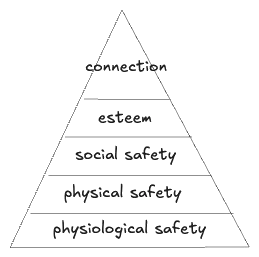
“Social safety” here means a freedom from abuse and ostracization, while “esteem” refers to social status, which may be seen as a safety from the exclusion from entitlements, attention, and respect. “Connection” here is quite a bit like Maslow’s original “self-actualization”, which I think of as including things like romantic relationships, artistic expression, and acceptance into a role in a community—broadly it entails “becoming a part of a larger whole”,1 and can perhaps be thought of as a “safety from disconnection”.
There is certainly some truth to this linear arrangement. Anyone who has felt uncertain about their basic physiological needs will be know that it becomes an obsession. I’ve personally spent just a few months on the brink of not knowing where my food was going to come from (an entirely self-inflicted situation due to dropping out of grad school without a plan and not wanting to ask for help), and even that was enough to be completely preoccupied with food: cutting costs obsessively, chasing coupons, skipping meals, etc. Something similar happens for physical safety, social safety, esteem, and actualization: a person subjected to violence will be defensive and reactive, a person subjected to abuse with defending themselves against triggers, a person subjected to a low social status will be obsessed with it. The need for connection seems to change abruptly around puberty: the innate connection to adults is suddenly severed, leaving many a middle schooler with a gaping pit of connection and esteem to fill, leading directly to the preoccupations with attention, romantic connection, and artistic expression.
We can make some improvements to this model. The pyramid shape hardly means anything; we may as well arrange the needs along a line:
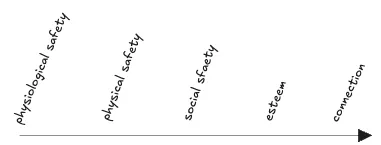
And the mere ranking of needs is too simple to be useful; some epicycles are needed.
Let us first distinguish the “short-term” and “long-term” versions of each need.
Observe that the “short-term” needs in the hierarchy will tend to be prioritized in hierarchy-order: short-term physiological needs (food, sleep) can necessitate risking one’s physical safety; people put up with emotional abuse and bullying (e.g. in an abusive workplace, especially in past eras, with slavery an extreme case) when the alternative is physical harm or worse; they put up with low social status when the alternative is abuse; etc.
Likewise the long-term needs: how does, say, long-term access to food weigh against long-term physical harm? Consider the villagers in The Seven Samurai2, who are forced to recruit help to fight against bandits rather than have their food be stolen at the end of the season. We see a long-term physiological need superseding the fear of violence, as well as the fear of violence superseding the social risk entailed by requesting the aid of the unknown samurais (who might themselves by thieves, rapists, would-be tyrants, etc., though it turns out well for them in the end). So long-term needs may be said to fall out approximately along the same hierarchy.
Now, how do short-term needs stack against long-term needs? What will a person trade away to avoid starvation in the future, say? Not their immediate physical safety—they’ll hold out for some unknown providence. But they likely will suffer mistreatment: if you don’t know how you’re going to feed yourself through the winter you will likely take any job, regardless of how unpleasant. What will a person do to avoid the risk of physical harm in the future? In generaly they won’t suffer abuse in the present—because abuse today may well become harm in the future; here I think of standing up to a bully—but they generally will tolerate a lowered social status. Roughly it appears the “long-term” timescale of each need is about on par with the “short-term” need two levels down, giving a need vs. priority relationship like the following:

We can also add to this schema the right to assert your needs. At what point do you cease to accept physical harms and risk death (the ultimate physiological risk)? Or, when do you cease to accept emotional abuse and choose to start a fight (a physically risky thing to do for anyone) or by quitting a job (a long-term physiological risk)? When do you cease to accept a low social status and escalate verbally? When do you refuse to go un-”actualized” and risk embarrassing yourself, say, by asking someone out?
These kinds of escalations are all expressions of anger. When our safety is threatened, at any level, we generally are willing to respond by threatening the offenders’ safety at the same level in the hierarchy or at any higher level. Our defense against violence is condemnation, then verbal force, and then physical force itself; likewise our defense against verbal abuse is condemnation. And before any of these, the first defense against any injury is disconnection: we close ourselves off to the offender as a threat.
But if safety cannot be attained by a response in-kind, and especially if our assertion of our need for safety is itself ignored or rebuked, we will sometimes be inclined to escalate to the next level (“down”, in Maslow’s original pyramid, towards the more fundamental need). Of course, some people escalate more quickly than others—I think here of both the short-fuse who will feel disrespected by anything, and of an dueling culture where men get into fights to defend their honor.
Of course, as we grow older and wiser, we learn to, in many cases, walk away or end a relationship rather than escalating; only if we expect the risk to continue or cannot afford to sever the relationship do we attempt to make our need be respected by escalation.
For a prototype of all such escalations we may take the primordial story of anger: The Iliad, the topic of which is given explicitly to be the anger of Achilles: “Rage—Goddess, sing the rage of Peleus’ son Achilles”. The plot of The Iliad is driven by Achilles’ escalation of his conflict with Agamemnon, from the level of “esteem”/“social status” (being a conflict over entitlements to the spoils of war, and over the relative ranking of king and the greatest warrior) to the level of “social safety” (in their heated feud at the beginning fo the story), and then to the level of physical safety (by sitting out the war and to invite the Greeks’ defeat).
For another example, consider the sequence of events leading up to the American Revolution. The original offenses were largely at the level of esteem/status, as the English trade policy benefited the England at the expense of the American colonies; only after a sequence of escalations did the conflict came to violence.
From these sketches it appears that “escalation” deserves one priority level higher than even a “short-term” need. Filling in our diagram:
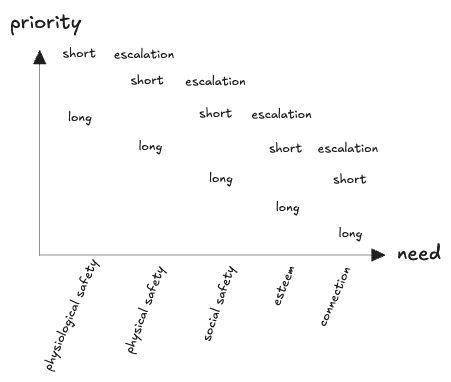
(I don’t think it makes sense to “escalate” beyond physiological needs—I suppose at the point where your physiological needs are repeatedly not being met, you die.)
This model of human nature is certainly not perfect, but it should give us enough structure to work with. Approximately we adjudicate between the many forces inclining us to action according to the priority-order given by the hierarchy. Expedience and convenience play a role, as well, and often are the primary criteria by which otherwise-undecideable conflicts of needs are determined. Most commonplace decisions are far-removed from existential or physical risk, generally falling around the level of “esteem” and a bit into “actualization”—to decide among these we mostly do whatever is most sensible at the time.
To be continued…