The Hierarchy of Needs
Epicycles to Maslow
Table of Contents
The Basic Hierarchy
I have need of a descriptive theory of human nature which is up to the task of describing the phenomena of this era, while also compressing compactly in the mind for deployment in other arguments. A perfect “model” is not needed; we can start with a basic picture and then layer on “epicycles” as needed to better fit reality.
“Maslow’s Hierarchy of Needs” will do as a starting point. Its basic prediction is that we humans act according to various needs, desires, and inclinations by prioritizing in a certain rank order. Maslow’s original ranking looked like this:
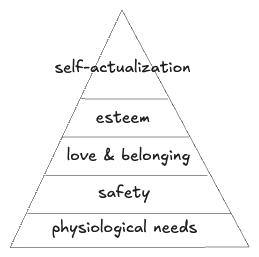
The lower levels of the pyramid are the “more fundamental” needs; the width of the bar can perhaps be taken to represent the greatness of the need. (Maslow himself apparently did not employ the pyramid shape, but it is conventional.)
The exact “needs” in the hierarchy are debatable, and I find Maslow’s levels to not be very useful. As a first revision to the model, I want to replace them with a better operating model of human nature. I come up with this:
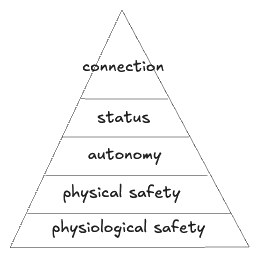
The needs are:
Physiological Safety entails the basic biological needs for food, water, sleep, healing of wounds, and recovering from illness. We prioritize these needs almost involuntarily, at least in states of extreme deprivation.
Physical Safety entails the avoidance of violence, pain, and physical injury.
Autonomy entails the freedom to bear one’s own opinions and beliefs and to speak and act according to them.
Status refers to one’s position and standing in the social plane. In many cases status is accompanied by entitlements—to material things, attention, and respect—as well as a safety from criticism, disrespect, dis-entitlement, and emotional abuse.
Connection. Connection primarily encompasses: intimacy, acceptance in a role in a community, and the ability to express one’s ideas (intellectual, creative, political, humorous, etc.) such that they are received and mirrored by others. Very broadly, “connection” means “becoming a part of a larger whole”, and can also be thought of as the safety from disconnection or alienation.
The basic prediction of my “hierarchy of needs” is still like Maslow’s—that at any point of time we will be driven to meet the most fundamental need in the hierarchy which is currently unmet. So a person with no access to food will risk physical injury to attain it; a person threatened at gunpoint will tend to do what they’re told; a person lacking in social status will act to win the attention and admiration of others; a person who is socially secure will tend to form relationships.
The purpose of this essay will be to justify this model and to develop it in a few directions.
The Needs
We’ll begin by explaining the hierarchy in much more detail, with the aim of justifying the ranking given. Along the way the “sense” of the hierarchy—what it means for one level to rank above another—will come into view.
Physiological Safety
That “physiological safety” is the most fundamental need is easy to see. A threat of death or serious injury overrides the brain with fear. Most activity undertaken at this level of the hierarchy is nearly involuntary.
The immediate fear of death is a powerful force; a “near-death experience” supposedly has the power to cast aside all other mortal concerns and vanities. But most of us have never experienced it.
More easily imagined is the natural aversion to walking near the edge of a cliff. Observe that this fear is not at all a social phenomena nor a choice. This fear can be superseded by other concerns (if trying to rescue somebody, or to show off your bravery), can be dissociated-from (if too preoccupied or foolish), or can be unlearned with experience (if you’re Alex Honnold, say), but not easily.
Likewise the need for sleep can be overridden, but not easily, and at some point not at all. What about hunger? Most of us have not felt so pressing a hunger that it overrides our minds to such a degree. But many people do—the poor and homeless even in affluent areas; whole populations in poor regions and throughout history. Hunger, we know can become mind-controlling: supposedly “every society is three meals away from chaos”; famine drives violence, more than anything else (although a cursory scan of historical evidence suggests famine only leads to violence when the state or ruling regime can be stuck with the blame).
Physical Safety
There is not really a hard line between “physiological safety” and “physical safety”. I think of the former as the fear-of-death itself along with the various involuntary avoidance responses, whereas the need for “physical safety” is more of a social phenomenon. Consider (if you’ve experienced this) the “aura” felt when a loaded gun is in the room with you. One cannot easily ignore it, though again, experience, willpower, and ignorance can disable this reaction. It is something like the fear of falling, but is obviously learned or absorbed socially; we are not born understanding guns, after all.
Knives are simpler to understand, but the aversion is still learned. (I can remember, at an early age, not having any particular respect for knives or scissors. Later I acquired a strong aversion to knives, but eventually gaining enough experience with kitchen knives to trust myself. That learned fear reaction still takes over when I instinctually recoil from a falling knife—and, good! It is far quicker and more clear than my rational brain.)
Another example: driving. We learn, by a sort of social osmosis more than rational thought, that the “double yellow line” dividing the directions of a road should be treated as a powerful psychic barrier, although we do learn to cross it under controlled conditions (left turns, passing on a two-lane highway). We hardly ever think about what would happen if we veered into the other direction of traffic. What lies across that line? A crashing mess of violence—no place for human flesh. Better not to think of it.
That the fear of violence supersedes autonomy is easily seen in the cases of robberies or muggings. Almost everyone will comply at gunpoint. For a more severe case, consider slavery—the mass deprivation of autonomy by a continual threat of violence. It is clearly the case that violence can be used to control people in the short term—but this is certainly not the case in the long term, as people also resist the deprivation of their autonomy; this we’ll come back to.
The first three levels of the hierarchy, then, have a relationship not quite as simple as a “priority order”. Instead each layer acts like a “buffer” against the lower layers. To lose “physical safety” risks the loss of “physiological safety” —if you are subject to violence and cannot defend yourself, death or permanent injury is a potential outcome. Likewise the loss of “physical safety” is the end state of the loss of “autonomy”—a person without autonomy (a slave, a soldier) can be subjected to dangers they would not undertake themselves, can be worked to exhaustion, or can be physically abused without means of reprisal—again we defend against the loss of autonomy to guard against something worse. All three layers ultimately guard against death.
Therefore as we continue up the hierarchy we might expect to continue to see each level acting as a buffer against deprivations on the previous level.
Autonomy
I am inclined to subdivide “autonomy” further into “autonomy of thought”, “autonomy of speech”, and “autonomy of actions”, with “autonomy of thought” the most fundamental of the three.
This is not a precise division, but it appears to be directionally correct—that people more readily yield to constraints on their actions than on speech or thought. Nearly all of us must work to live, and most jobs entail voluntarily doing what someone else tells you to do, after all. Yet we generally expect to be able to speak our minds, at least in private, and consider an employer placing restricting our speech to be an overreach except in certain cases like NDAs. Likewise we, for the most part, voluntarily adhere to the laws of the land, and its many restrictions on behavior, but assert a constitutional right to free speech as more essential than the mere following of law. Evidently speech is more closely-guarded than action.
And autonomy-of-thought (or -of-beliefs) appears to be guarded more closely than that of speech. We appear to possess natural psychic resistance against the incursion of other people’s ideas into our minds. When exposed to any idea originating outside ourselves, we check it against our own senses of what is true and good, and consider whether its source is trustworthy, before granting it a status of “true” or “morally important”.
If repeatedly exposed to ideas which we do not accept, or have not decided whether we accept, we resist. We first brush them off, then grow defensive, then grow angry—protecting our own thought process from being overwhelmed. This is a defense against intellectual or moral confusion, primarily—against the loss of a stable sense “what is true” or “what is good”—this latter sense being a map of who and what in the world is trustworthy and worth defending, of whether we are good and deserving, and of whether life itself is generally good.
This natural information-screening process can fail for various reasons, among them exhaustion, isolation, and overwhelm. Examples are numerous. Military bootcamps serve to break new soldiers of their innate autonomy, substituting in its place a group solidarity and a strict respect for hierarchy. Cult indoctrination and political propaganda work similarly. Abusive relationships also: repeatedly forcing a person to repeat, acknowledge, or address a partner’s feeling can eventually break their brain. In some cases the overwhelm can be purely intellectual, without any real anger of force being employed—a sustained assault by rational arguments and evidence can still work its way into a mind and uproot the belief system already there.1 2 3
It may seem too in-the-weeds to include a theory of autonomy-of-thought here. But it is really key to the overall model—it is this, more than anything, which explains the phenomena of political polarization; this is a central aim of the theory.
One might think that we human beings, faced with ideas with which we disagree, could simply hold them at a distance and respect the right of others to disagree. Empirically this is not generally true, as the internet shows us. The reason I think is that repeated exposure to disagreement keeps the mind’s psychic boundary-defenses in a state of constant arousal. There is too much confusion already; we rarely have the chance to retreat back to safety; ideological enemies are always at the gates (in our phones); we must be ready to defend against any threatening idea at any time; furthermore, the moral lines of the world are all confused—technology changing, modes of production changing, the economy is ever-restructured in the interests of we’re-not-sure-who, we do not trust our leadership, we are constantly at risk of exposure to the tectonic forces of geopolitical trends, not to mention environmental calamity… amidst all this our minds cannot relax, cannot trust that things will be the same for five years or ten, must keep our weapons in our hands.
Then when we go into the world we are encountering other people in this same psychic state—defensive, reactive, overly assertive, ready to fight. It is not easy to maintain our own composure when faced with this; our respective psychic configurations are natural enemies, having been strongly selected to antagonize each almost instantly. Few of us possess the skill to conduct a conversation in a fashion which respects other minds’ rights to autonomy-of-thought—for it is a skill, and all of this a skill issue. We expect to be able to get the safety we need by stigmatizing and shaming offensive ideas out of existence. This would work within a single tribe, where values are largely aligned, but these are status attacks, which in the present model are less important than autonomy-of-thought—so these attacks, when wielded against ideological opponents, wind up antagonizing them and provoking reaction. For examples, consider any battleground of the culture war.4
Status
“Status” I have characterized as position and standing in the social plane. This is, pointedly, not a one-dimensional “pecking order” with “alphas” and the like; that model is not a good fit to empirical reality. (It is not even a good fit for wolves. Wolves, apparently, don’t even fall into a rank order under an “alpha wolf” except in captivity. Wolf packs are families, and in the wild a pack acts exactly like you’d expect a family to act—sharing food equitably, caring for their young, etc. Likewise humans don’t appear to form into strict linear hierarchies either, except in confinement—prison, school, and conditions of material scarcity.)
The social “plane” is high-dimensional: people regularly move laterally and carve out new niches for themselves—new ways of playing a part in a society and earning respect.
Conventional social status of the middle-school-cafeteria flavor is only one kind. Others include: the primitive sexual hierarchy of young men, shared also with apes and many other mammals—who has access to female attention and sex? Legal status—who is entitled to rights and privileges by law? Intellectual status—whose ideas are taken seriously? Whose ideas are trusted vs. ignored or dismissed? Emotional status—whose concerns and feelings are taken seriously? Aesthetic status—who has good taste? Who is considered impressive, distinctive, or attractive vs. crass, inauthentic, etc. Another: wealth, money, income.
For example: a musician, a professor, and an athlete do not really rank against one other—all can be respected in their own domains, though different people may esteem them differently, and they may at times be reduced to a single ordered “status” dimension (according income or fame, say).
Of particular interest is a status I’ll call “moral standing”—the state of being “in trouble” vs. “in good standing”. Here we see a status which exists both in social reality as well as in the emotional reality of a single person—to reprimand or punish a person is to threaten their moral standing, usually with the aim of controlling them.
In general, high status amounts to an entitlement to autonomy. To be high status, in any particular sense, is to be more free in that respect, both in that one’s freedom is acceptable to others and also that it is thinkable and acceptable to oneself. For example, a person whose “conventional social status” is low is not socially free—everything they do must be under the threat of shame or mistreatment. I picture a stereotypical dork at a high school: they can’t say or do anything without being mocked, they have no recourse when people are mean to them, they certainly can’t ask a girl out—the social landscape is too treacherous; the fear of shame overrides and controls them. Likewise an abusive boss who puts down their employees does so to control them. Likewise status-jockeying along the primitive-sexual-hierarchy dimension is generally aimed at controlling access to women and sex—again low status translates to a deprivation of freedom, both internally and externally. As extreme cases I think of Bronze Age kings with fifty wives, or of “prima nocte” (though I hear this may be made up).
We can see the phenomena of “status as entitlement to autonomy” playing out also among entire classes and castes, in historical cases where social or political revolutions have rewritten social hierarchies. Liberalism and the philosophy of “natural rights”, say, are an assertion of an entitlement to certain kinds of autonomy, contrary to the entitlements accorded by feudal status hierarchies. The Civil Rights movement was assertion of legal and social status, necessary to acquire a freedom from deprivations of autonomy continuing well beyond the legal abolition of slavery. Feminism, in its early forms, was essentially a movement to acquire legal and social status and therefore autonomy. Etc.
Connection
The general sense of “connection” is of “becoming a part of a larger whole”. I named three kinds of connection above: intimacy (including physical affection and sex), acceptance in a community, and the expression of one’s ideas such that they are received and mirrored by others.
Each of these occurs naturally once a degree of status is attained within society. Obviously social status (or primitive-sexual-hierarchy status, in environments where that system dominates) leads to intimacy and sex being attainable, whereas in the absence of some social status it is as hard to ask out a crush as to walk off a cliff! Community-acceptance can be seen as an extension of “moral standing”. And the remaining sort of connection—expression and mirroring, being known—comes in many forms, corresponding to the many possible dimensions of social status.
Evidently “connection” is an outgrowth of status, and so it appears to belong higher in the hierarchy.
This definition of “connection” is actually very similar to the correct sense of Maslow’s self-actualization, but that sense seems to have been lost in the “corporate striver culture” version of Maslow by the time it percolates to the general public. See here for a sappy progressive-inflected account of Maslow’s actualization as “becoming part of a larger whole”. In particular, the striver-friendly/Nietzschean-sounding drive to “become everything that one is capable of becoming” does appear, but only as an immediate aim rather than as an ultimate goal. Actualization-in-oneself is not an end-in-itself; once “connected”, one by definition is part of a larger whole—a family, community, movement, or culture—with its own hierarchy of needs, and will then be driven to serve the needs of that whole. Here we see hints of an appropriate place for “empathy” in the Maslowian picture.
With this we conclude our tour of the hierarchy. But it is clear by now that the basic “law” of the hierarchy—that we prioritize lower needs over higher ones—is not quite the right picture of things, in a number of ways.
Furthermore: this is all too complicated. The basic Maslowian “priority queue” is simple enough to think with, but this, I’ll be the first to admit, is unwieldy—too nuanced and idiosyncratic. We will need to distill something simpler from this mess if it is to be useful.
Redrawing the Hierarchy
Let us extract from the preceding discussion some observations which seem to contradict the basic hierarchy-law. Each will suggest a redesign of the whole model; for now we will reserve judgment as to which course to follow.
Trust
First: we observed a few times that layers of the hierarchy appear to serve as a “buffer” against deprivation of the previous layers. In this view the dynamic of the hierarchy appears to primarily involve trust. To be safe is to be able to trust you are not at risk of injury or death. To be autonomous is to trust that the responsibility is in the hands of the one person not likely to deprioritize you—yourself. Status amounts to trust in safety from coercion, connection to trust in safety from status-attacks—once bonded and known, one’s place in the community is guaranteed.
This is not a bad view. It is not quite the original “priority queue”, as it identifies each level as an “outgrowth” of the preceding one. Autonomy confounds this view somewhat—there’s not an obvious place for “autonomy of thought” or ”… of speech”, and the presence of autonomy in the hierarchy at all seems optional: if you could trust the community would keep you safe and meet your status and connection needs you might never have to become autonomous at all; or, if the whole community was facing some threat, you might voluntarily surrender your autonomy to serve the cause against it, e.g. as in military service.5
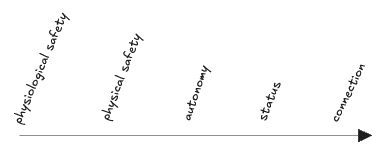
In this view we may as well just depict each need on a line:
Or we could plot the descending priorities on a second axis:
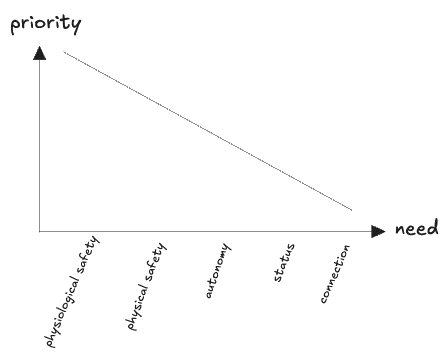
An advantage of a view in terms of “trust” is that it leads us to considering the difference between short-term and long-term timescales of each level of the hiearchy. It’s agreeable that immediate physiological and physical safety trump all else, but how do long-term needs stack up? How important is it that we trust we’ll have food next winter, say, or to be free from random attacks on the street? Likewise, how important is to have autonomy later, as opposed to working an over-restrictive job (or in past eras, being a slave or servant)? How long will we go without status, without connection? What, in general, will we trade away now for safety later?
Let’s probe a few of these questions until we arrive at a provisional answer.
What will a person trade away from food in six months? Not immediate physical injury, but, they will yield their autonomy—they’ll work a job for someone else.
What will a person trade now for security from violence in the future? Not just autonomy—you would trade autonomy-now for physical-safety-now, as in a mugging. You might submit to a social hierarchy, though. (It is plausible that the original genesis of social hierarchies between rulers and ruled emerged from such a tradeoff. Supposedly organized states emerged to protect sedentary populations from violence. Although, it’s not clear to me whether this emergence occurred internally and voluntarily (as alliances of mutual protection, internally and non-voluntarily as in organized crime, or as externally as in a protection racket or a long-lived extortion).
What will a person trade for long-term autonomy? Short-term status yes, short-term connection also yes, I think—here I think of someone grinding or hustling, or migrating, to make a better life for themselves before settling down and marrying and the like.
Approximately it appears we trade our long-term needs away around two priority-levels down:
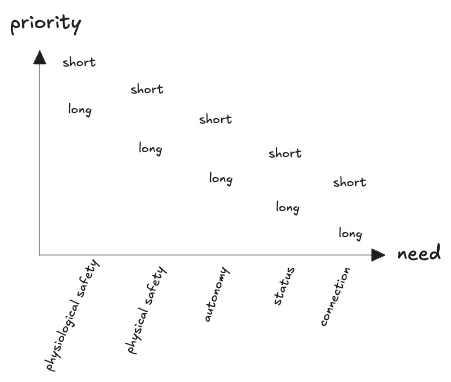
Likely this revision to the basic model won’t hold out well under much more scrutiny than this. But it will do as a starting point.
Fear
Second: the hierarchy of needs lends itself to thinking of the lowest levels as most fundamental. But if I consider, say, my own adolescence, I recall clearly experiencing the need for autonomy and status as instrumental to the need for connection—as a drive to be seen and respected and to win the attention of women; ultimately as a drive for sex and intimacy. Other ideals were mixed in with this—the desire to say and experience novel things, to create great music, etc.—but all were aimed towards things I have categorized under “connection”.
This evidence suggests an opposite way of thinking about the hierarchy, where “connection” is the most fundamental need and the others merely take their place as obstacles which must be overcome in the pursuit of connection. The lower levels are higher-priority only in that they represent more immediate concerns—danger occurs now, whereas connection can wait; it need only happen at all.
This suggests a view of human nature as expanding into the available space, and then turning back when it comes up against the sharp edges of reality. Imagine a child showing off how fast they can bike down a hill, only to be struck suddenly by fear when they realize they cannot control the trajectory. Or, a child acting performatively in front of their class, only to be struck by shame when they realize it’s not getting the reception they imagined.
The lower levels of the hierarchy all then take the role of “fears” which curb our self-expression. We might relabel accordingly as a “hierarchy of fears”:
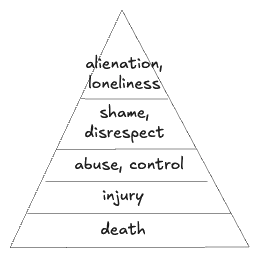
This fear-view is essentially equivalent to the “priority queue” view of the original hierarchy, except that it identifies the lower levels of the hierarchy as interruptions in the pursuit of the highest level, which I find preferable.
To think of human nature as being governed by connection-but-for-fear, suggests a view of all of human history which I find extremely compelling, and even moving. We humans, under conditions of fear—in times of conflict, collective scarcity, or confinement—are reduced to something like a state of nature, governed by little more the need for safety from violence. The social hierarchy grows stiff as autonomy is squeezed out; pro-social behavior can cease to function at all, as all collapses down to a single dimension, with physical power is the final currency. But in times of peace and prosperity the grip of necessity releases, and we can “let a hundred flowers bloom”: identities grow out in every direction, seeking niches for themselves within the social plane. The modern world is as far into the latter paradigm as has ever occurred.6 7
Thinking of the hierarchy as representing fear seems also to accord with the view of timescales, just discussed. An immediate fear, after all, drives an immediate reaction; a fear of some threat in the foreseeable future instead produces anxiety and preoccupation, and perhaps preparatory planning. Faced with multiple competing fears at different timescales we will try to solve and plan for everything at once—this is the function of much of rational thought. And trust—in others, in our own preparedness, or just in providence—is what puts a fear to rest.
If we are to think of humans as pursuing connection-but-for-fear, we ought to incorporate also the observation that humans have a baseline appetite for fear—that the optimal amount of fear is not zero, and in the absence of much to fear ourselves we will seek novelty, excitement, or drama to find something useful to think about. (I think a fair amount of what we find entertaining can be explained in this way, e.g. horror movies) Alternatively we might lend our minds to the problems of others—and here we can locate much of political and moral thought, as well as much of the basic curiosity and the compulsion to find and clarify patterns which underlies science. For the most part politics and science are usually not concerned with our own practical problems. Perhaps the drive to seek things to fear or problems to solve deserves another place on the hierarchy? Or perhaps we can see these as bids for status or connection.
Individuation
Third, when we discussed “status” and “connection” we emphasized that there appear to be many competing status hierarchies, and many competing ways to integrate into a community, rather than a single one. This suggests a visualization like the following,

with many adjacent hierarchies which overlap on their lower, physical concerns but diverge at the highest levels.
The multitudinousness of the status- and connection- levels suggests we think of the hierarchy as describing, not a priority queue, nor a drive towards connection alone, but as something analogous to cell division & differentiation, aimed ultimately towards the growth of a larger organism:

(Here I’ve depicted mitosis, but of course we have two parents and meiosis may be a better picture. Perhaps picture should be taken to represent the mind or will of an individual emerging from that of its community.)
The idea is that a human being is, originally, dependent on the community-organism in which they are born. As we grow, we are driven to separate ourselves from the collective and to form bonds back into that collective by which we can sustain ourselves, with the eventual aim of being separate-but-connected. To do this we “individuate”—we become a certain kind of person (just as a cell becomes a certain kind of cell), by solving in some way for status given our natural talents and inclinations, what is valued by others, and whatever we come to discern as good-in-itself.
It should be said that the end state need not be a larger organism. If the bonds do not grow strong we may wind up only loosely-linked; if we repel each other the end-state may be complete disconnection:
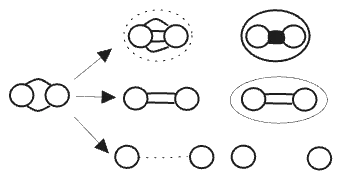
This suggests a view of the hierarchy-of-needs as emerging from an interplay between a few “forces” or drives8:
- The drive for individuation, which drives us towards autonomy, expression, and the pursuit of the highest good we know of. (We could also identify this with “courage”?)
- The drive for connection, which directs individuation towards that which is valued and high-status.
- The fear of death, injury, deprivation, or alienation, which acts in opposition to individuation, keeping us from straying too far.
One could try to arrange these such that one is primal. Is individuation instrumental to connection—do we seek status to acquire attention? Or is connection instrumental to fear—is the point of connection to stave off the death of our genes, or as a buffer against scarcity? Perhaps in an evolutionary sense?
But I think the opposite stories are just as easy to tell: that the end goal is individuation, to become oneself and express one’s sense of good, and connection is a way of reproducing what one becomes and expresses. Or, that fear arises when our prideful individuation and grasping towards connection come into contact with physical and social reality—that pain is information which directs us towards becoming something viable and self-sufficient; it is the means by which we learn what is good. Or, that fear only exists to sustain us until the point we are adequately connected, at which point we may be willing to sacrifice ourself for others.
It may seem that fear must win in the end—we are mortal, after all. But is it not the case that the capacity to have children is the ultimate expression of connection, and that our children themselves represent an ongoing force of individuation? I do not think any of these forces can truly be said to be primal. The ultimate sense appears to be that these three forces work together to bring about the “multi-cellular”; they exist to realize that latent idea.
Collective Needs
Fourth, a view already gestured at many times. An individual human has their hierarchy-of-needs, but so too does a community or society as a whole.
Under two conditions the needs of the individual yield to those of the collective: under conditions of scarcity or stress, when the collective enforces moral alignment against the threat; or, when an individual has achieved their own need for connection, is adequately knitted into the social fabric, and naturally turns their view outwards.
Furthermore, we can draw the “boundaries” of the collective to which a hierarchy-of-needs model might be applied in many different ways.
By relationships: the individual—a married couple—a whole nuclear family—an extended family, extant over space and generations. By space: an individual—a household—a neighborhood—a village, town, city, country.
By identity groups—identitarian politics, such as the Civil Rights movement, are an expression of autonomy- and status- needs at the level of an identity subgroup; and, like any collective, the identification with one’s group as a moral unit, and the prioritization of the group’s needs over the individuals, is emphasized when a group is threatened as a whole—meaning that e.g. race-based political unity is not a permanent identification, but a contingent one, employed when it offers a defense against the fears experienced by the individuals.
Likewise for political parties: American leftism and rightism are two separate groups with their own hierarchies-of-needs, and much of culture warring is, as observed above, a battle for autonomy-of-thought, -of-speech, and status between these groups, and is, I think, essentially unrelated to the topics actually being argued-about. (Both parties find it useful to aggravate the fear of violence and death to their own advantage, though. To avoid this, one must calibrate one’s own survival fears only to what you can see with your own eyes.)
Likewise for social classes: socialism, say, can be seen as a contingent alliance of working classes against collective oppression (which of course it is!). Likewise for nationalism, which seems to have exploded out of nowhere in the Europe in the 1800s to oppose the status hierarchy of hereditary nobility. The interesting part is that these solidarities are, in the long run, contingent and shifting—are adopted to fight the battles of the day. Whether a group appears as a moral unit is socially-constructed, but social constructs are real, and the hierarchy-needs which they form to defend are real, whether you find the lines of solidarity convincing or not.
To view the hierarchy-of-needs as not necessarily applying to an individual, but instead as applying to shifting “collective entities” whose natures depend on circumstance and which may overlaid with each other, probably leads to the most predictively-powerful Maslowian model. We can more-or-less identify speech itself as acting like the thought process by which these collectives’ are negotiated, and the means by which collective-entities themselves are established and rearranged.
There is an enormous amount one could say here; this “scale-invariance” view of the hierarchy-of-needs is a whole theory in itself. I will observe only a few things.
Much of the history of human revolutions is, as far as I can tell, the product not of hierarchy dynamics themselves, but of the negotiation of these collective identities to which the hierarchy may be applied. The Church claimed to be one immortal human body; the Protestant Reformation disagreed, as did a thousand later schisms. Feudalism essentially relegated the majority of the population to the role of disposable agents, limbs, or tools. For a long time the forces of aristocratic entitlement reigned dominant, until the written word and technological progress set the middle classes free, and the lower classes to a degree. And what they came up with was liberalism; a system whose basic axiom is “freedom of speech”—the right to negotiate one’s own collective-affiliation.
“Autonomy-of-speech”, which so far has been something of an oddball in the hierarchy, then appears as a basic assertion of either one’s right to participate in the thought process of its collective—rather than only being an compliant agent of another will—or, as an assertion of one’s right to cultivate other collective identities besides the nominal one of one’s tribe or nation etc. This right to not identify solely with one’s nation is the basic principle of liberalism then, and I think this is the right way to think of liberalism—not as a philosophical project, but a psychic or psychological one, with the philosophical and metaphysical systems existing to buttress the basic psychological autonomy need.
Individual “connection”, in the collective view, seems to entail one’s becoming a moral constituent of the collective rather than a low-status agent, limb, or tool. In the cell-division view, we saw that one must separate before one can connect again as an equal—and to separate, one must be able to speak and act autonomously. To be unable to act is to be a tool, and tools exist, in the mind of the tool-user, only as an extension of himself, and disposable. These, evidently, are the threats which autonomy-, status-, and connection-needs exist to oppose. Evidently, we can add to our set of fundamental forces a fourth, the force of “control”, whereby ruling castes relegate others to subservient roles.
The perennial risk of discussing “social organism” theories like this is the sort of imperious mind who would happily decide to “cut off the hand to save the body”—as if any of us would cut off our own hands in anything less than the most extreme conditions imaginable! Yet the entitled mind, as soon as it is given license to consider a collective like an organism, immediately relegates some large fraction that collective population not even to the status of limbs but of tools. Connection, understood properly, is a freedom from this—from the ignorant or entitled overreaches of others.
Finally, we can find in this model a place for “empathy”, for empathy arises by nature towards anyone we come to view as part of some collective body to which we also belong. Once we see someone as one-of-us, as made of the same thing of us—even if only in that they are human, or even that they can feel (as in animals) or simply think (now that AIs are in consideration)—their concerns are ours, to some degree. Human empathy can be aroused towards anyone who can be humanized by a story; such a “body” is formed by the resonant sense of shared-humanity. (Is this what is meant by “love”?) Likewise empathic connection can be broken—by stories of selfishness, of entitlement, by casting others as uncaring, as unacknowledging of humanity, or as corrupted, as enemies, as criminals, as subhuman animals, as automata, or as mere forces of nature… (And is this then hatred?)
Freedom
A fifth and final view of the hierarchy.
Observe that a person facing death has only one option: to try to survive. One option leaves no room for choice.
A person faced with the threat of violence can choose to fight it or not. They have two choices.
And I have heard it said that you only really have a choice in life when you have three options—it’s nearly impossible to leave a current job when you only have one other option before you, say. At three options you have a degree of autonomy.
After that the plane of status then opens up before you—all of the other aspects of life in which a person may, by acquiring the confidence to move under their own volition, be freely.
To move up the hierarchy, then, is to become more free.
In a prehistoric environment we humans could never be completely free of the constraints of reality—of Ananke, “Necessity”. The ancient human had to live on faith: that the winter would not be too harsh, or that calamity would not come; there was nowhere to turn when fate turned against them. At almost every moment the ancient human’s actions would have been determined by what was necessary, and the blooming of individualism would have been a rare and special occurence.
Then, it is said, Prometheus stole fire from the gods as a gift for the pitiable humans. Prometheus means “forethought”: what set us free from the darkness of prehistory was the faculty of pattern-matching, for inference and extrapolation, and the degree of control over our environments which these faculties provide. Mankind had no longer to live on faith in divine providence, but could now hope—with a rather different character: a presumption of safety rather than of danger, a default aliveness, but which relies on our own efforts succeeding—we hope a plan works, we hope we thought of everything. The fire is hope. A fire can be kept alive, but it can also be extinguished. From fire the rest of civilization follows.
Now the borders of reality—from which food springs into existence, where death awaits; Ananke’s domain—are far off and forgotten. Necessity still acts on us, but almost always in a distant and unclear way. By the time the force of nature reaches us it is many-times refracted, its vector fanned out in myriad and shifting directions. We buy our food at supermarkets and worry over money, rather than worrying over the food itself—crops, animals for hunting. Other people, largely, build buildings and handle waste and fight wars. We can hardly fix anything ourselves, so we put everything into words: as politics. At best our words join up with other voices’ words and find their way to someone who can do something. At worst they swirl forever uselessly.
We live in a world governed primarily by what would have been the furthest outlying forces in ancient times—status-games of all kinds, and the yearning for connection. We should be free to thrive. Yet we are, by and large, confused and alienated, “mentally ill” and the like—why? All this freedom has alienated us from our natural sovereign—reality itself. It is no wonder we are confused. Even if we are safe we cannot tell we are safe; we can barely understand the world we live in or what the forces are which keep us alive year-over-year. Even the ancient humans, exposed as they were to the vicissitudes of fate, could understand the forces acting on them.
This view suggests we draw the hierarchy as an inverted triangle:

The side-walls can be taken to stand for the constraints of reality, which, as our needs are met, peel away to open a space to move freely. We float back and forth in the higher echelons, as if adrift in a vast ocean, the social universe, only rarely coming into contact with the boundaries of reality.
Faced with the confusion of the open ocean, one has a few options.
We can go with flow—we can live in the social world, play the part it asks of us, strive for socially-constructed things, fire off our thoughts and feelings and hope they find their way to wherever they need to go. Here our hope for future providence must be placed in the collective—that it at some level is prioritizing the things it needs to prioritize; that adults are in charge, or that market forces are up to the task. That is: we live on the same hope which set the ancients free from their fear. But this hope can fail if we lose trust in the socially-mediated system which sustains us. The fears which arise when this hope is dimmed are those which feel apocalyptic, I think—common in our time, variously centered around the environment, immigration, AI, capitalism, etc.
An alternative is to swim for shore—for the periphery of society, for the walls of reality, where the rules are clear and ancient. This entails growing your own food and taking responsibility for our own safety and the like. This too is common in our time.
A third option is to seek control: to ensure our safety by coercing the whole social collective to attend to our concerns. This is political discourse, common in our time. Here we are limited by our ability to comprehend the whole, and by the status- and autonomy- needs of those involved, barriers to the free flow of practical information. Autonomous, status-satisfied, integrated individuals are, I think, capable of genuinely collaborating on the practical problems of life, so long as they comprehend clearly what it is we’re all doing here. Anything less is prone to go haywire, leading to all the strife of political polarization, also common in our time.
Is there anything else? Is it possible to return to that prehistoric faith? To live gracefully within the freedom of the modern world without grasping for control or fleeing for the shores—exposing yourself to fate to the degree an prehistoric human would have had to? Even if possible, is it good?
I do not know. But I am satisfied to have distinguished faith from hope, and to have placed each somewhere in this map of human nature. Thinking along these lines exposes the extent to which I never consider the forces of reality itself; I certainly am among those far out at sea and largely lost. I have felt the draw towards the shore, but the present abstraction suggests other courses—these are thoughts which would be hard to have side-by-side without such a model to place them in relation to each other.
Parting Words
I have by now said so much that I am more confused than when I started.
The above will hopefully be fruitful as a starting point for further efforts. If nothing else it has brought into view the breadth of phenomena which demand to be explained. And the epicycles we have spun out as revisions to the initial Maslowian model give some indication of the direction to follow—of human societies as a shifting mass of group-affiliations; as a collective dynamical process playing out on a substrate of individual human needs; of a general interaction between two pairs of opposed fundamental forces: fear vs connection (desire, which matures into love), and control vs. individuation.
It must be noted that this is only a descriptive theory. I have not, except at certain points, taken a stance on what is good—what is depicted here is only an attempt to say what is natural, i.e. what happens by nature. Yet one must understand our nature to say what is good: first because what is natural is easy, is self-gravitating; second because moral judgement arises within this system, usually in the course of autonomy- and status- conflicts, we humans being organisms subject to the law of nature here described ourselves; and third because in many cases what is natural is good, and much of what we tend to quarrel about morally involves, specifically, the negotiation of hierarchy-need conflicts between different individuals and collectives—a fact obscured by conventional moral discourse. Perhaps an answer may be found if we can converse in a language which better corresponds to the phenomena.
Lastly I must note that this is not really even an argument for this theory; I am not trying to convince anyone of these ideas yet, but only to illustrate them. I am not even convinced of this myself; I think Maslow is essentially the wrong starting point for a useful theory of human nature, but it has the advantage of being easy to think with and suggesting a lot of elaborations. I tend to think the real difficulty in making progress on generational philosophical problems is “model synthesis”—the construction of paradigms, which must be sufficiently parsimonious if we are to think with and to propagate them in words, while being up to the task of saying something useful about problems which need answers (how to stop political polarization, what to do with capitalism, how to save liberalism from the backslide towards autocracy, how to stop wars, how to love life and stop our lives from being invaded by other people’s strife, etc.).
Our normal instinct, when faced with these kinds of generational moral questions, is to gather what evidence we can and re-express it into the collective, hoping it might reach someone else who can do something—the fabled “adults in the room”—or at least someone who might assemble it into a useful theory. As such the and the world is overfull with evidence for or against one ideology or another, but far short on adults and theories. My aim here is to take a bite of the evidence which has reached me, and to digest it properly, to metabolize it into something—a constituent part, or a starting point perhaps—of a theory with some potential to make progress on such problems.
-
By and large we allow our minds to be open to those we trust, and accept the overwhelm of psychic boundaries when circumstances demand it. It is therefore not the case that overwhelming the mind in this way is necessarily a bad thing—no more than exercise temporarily overwhelming the body is bad. Certainly it depends on your stance on the thing doing the overhwleming. The military, obviously, prefers to overwhelm soldiers’ minds; the soldiers may or may not, depending on how noble they believe their military to be. Likewise we think of cults as bad but not, of course, when they’re your religion. We can also find in this model an explanation for the seemingly counterproductive overnight shifts new doctors are usually subjected to—the purpose is to overwhelm the mind, and to wipe out one’s former identity to an extent; in this way you “become a doctor”; it is not enough to simply “know medicine”. Likewise this suggests an evolutionary purpose for the difficult sleep schedules of new babies—evolution has found it effective to exhaust new parents such that they lose some of who they used to be and “become parents”. In both cases I use “purpose” in the sense of an evolutionary incentive—so medical programs which aim to create successful doctors may select for exhausting residency schedules even if no person ever consciously comprehends that this is instrumentally useful to their ends. ↩
-
Education, obviously, injects a great deal of knowledge into the mind. So long as we trust our educators, or at least trust that what we’re being taught is in some way aligned with our sense of what is good and necessary, our minds are open to it. But when information comes in too fast, or is too unmotivated, or disregards the dismissal or outright defiance which is characteristic of the psychic boundary, we turn on our educations, we do the bare minimum, or even less, and must be continually motivated by fear to stay interested at all. This is no way to learn—it’s very ineffective! Part of the reason tutoring is so effective is that it is responsive—both to the mind’s need to attempt to re-emit and articulate the things it has learned, so as to ratify its tentatively-constructed map of things, and because tutors can react to psychic defenses and back off or re-explain as necessary. Orthodox classroom teaching does none of this, and only works to the extent the student is already motivated—by wanting to be there—or is kept in a state of fear. The AI and adaptive tutoring software we’re seeing come onto the market these days is an improvement, at least in that it can respond organically to misunderstandings, rather than treat these as failures of discipline. ↩
-
Here I think of the various cult-like groups and psychoses adjacent to “millenial Rationalism”. The downside of a rationalist worldview (and perhaps of high-functioning autism in general)—which tends to sustain its own conceptual and moral maps of the world, as opposed to deriving its moral map from social consensus and trust—is a high risk of either runaway psychotic ideation, or of being disarmed and effectively subjugated by other confident minds, if those other minds are able to sustain a barrage of credible arguments for long enough. The confident invading mind here is simply more coherent, less doubt-ridden—it is not that it is truly “more correct”, except inasmuch as confidence aids in thinking, but that it is aligned around some powerful underlying emotion—grief, eschatological world-hatred, messianistic narcissism, etc., allowing it to justify its encroachments to itself. ↩
-
Consider gender—whether non-binary genders or transgender people are essentially that way, whether it is good to express these things, etc. In the feud over such an “issue”, what is really being debated? Not any claim about empirical reality, not the correct conclusion to draw from any mutually-understood body of evidence—the discussion never reaches that point. The conservative position on gender, as far as I can tell, is actually this: the leftists do not get to change our minds, and certainly not to rewrite our values—not by way of any academic or scientific argument; not unless we trust you share and respect those values, which we don’t. This is a defense of autonomy-of-thought, not a rational argument, and, per the present theory, is essentially impenetrable by anything short of violence. The left then misunderstands these stakes and frequently presses these debates to the point of radicalizing their opposition—radicalization and hyperreactivity being the psychic defense mechanisms which arise when autonomy is threatened. No such “status attack” will ever work—no amount of moral condemnation, nor rational arguments. It is more important to not be controlled than to be good, right or liked. And again, this is the human mind working as intended—it should not be surprising. ↩
-
I think it likely that a strong drive for autonomy in the young is historically unusual, and is contingent on the conjunction of two factors: first that one’s own community, values, and leaders are not credible; second that we have great access to information about the external world, with its great diversity of memetic input with which we can identify and towards which we are drawn. These are obviously not distinct—it is the external world which makes the community itself appear unconvincing. That the autonomy-drive is not essential I find suggestive, because of the degree to which people do readily surrender their autonomy to movements—religions, leftism, MAGA, nations, e.g.—which they find morally compelling and trustworthy. In this light the drive for autonomy arises as a rejection only. Note that this does not make it a bad thing—if you’re rejecting the values you were born into, you’re doing so for a reason, even if you can’t articulate it at the time. ↩
-
In the present descriptive theory this blossoming is “natural”, it occurs by nature. It is not necessarily good. But I do think it is also well and good. There are some who try to enforce scarcity-mindset social norms into the present day, especially for men—i.e. fascists, anyone who would use the word “alpha male” and mean it—but, what is the sense in treating a time of prosperity like one of scarcity, or vice versa? It is good to be well-adapted to one’s environment; it is good to be fit for scarcity only in proportion to the risk of scarcity. To win at peacetime is takes another skillset entirely. What it takes to win at peacetime is, first, technology, and secondly justice—the means by which peacetime remains such. And what equips one for justice is (or should be) the study of the humanities, done properly (this is a thesis for another day). ↩
-
An important caveat in the modern day: fears can be constructed; what people are afraid of depends on their information environment, but, to my eye, appears to be almost entirely divorced from reality, take the Haitians-immigrants-eating-cats fiasco for example—a non-event which a huge portion of the right-wing internet, the vice president included, is convinced did occur, or is at least “morally true” despite not having literally not happened—a maddening phenomenon. ↩
-
Compare all of this with the Greek sense of Eros acting as the sole life-force, or the dichotomy of Eros & Thanatos of Freud. Were I to assign Greek names to these forces, I might choose Eros for connection, Ananke for fear, and Dionysus for individuation. Ananke (Roman Necessitas, “necessity”) f here gives fear the sense I prefer: pain is information about what really exists; the “gravity” of physical reality, after Simone Weil. I suppose we could make Thanatos work for individuation as well, with a sense of a death-drive. “Metamorphosis” might also work—not a god at all nor even Greek, but like Ananke something of a natural law. ↩