Inertia and Interactions
- (This post)
Table of Contents
- Introduction
- Dynamics
- Surfaces
- Internal Motion
- Memory
- Distinctions
- Waves and Particles
- Internal Representations
- Human Nature
- Internal Dynamics
- Outro
Introduction
This is the first post of a series on “moral physics”—a theoretical description of morality and human nature which will borrow heavily from theories of physics.
A bit of context: I find the process of thinking to be like laboring on a jigsaw puzzle, but without knowing the end goal—there’s no box with an image on it. Instead we have in our minds fragments of many thought patterns, each like a puzzle piece, which we fit together tentativly as we try to form an argument or follow the thread of an idea. Should they snap into place the pieces will remain attached, and the combined piece can act as a single element in larger thought-patterns; if not we dismantle the thought, forget it, and try another. Much of the labor of thinking, then, consists of spotting patterns and sorting ideas into clusters, just as we would begin a puzzle by sorting the pieces by color or pattern. And, among all these ideas, it is those which are especially concrete—math, logic, and physics—which play the role of the “edge pieces”, who can supply a stable scaffold to which other ideas may be attached. Much of the intellectual development in history has in this way grown inward from the math and physics of its time, and it continues to be the case that is easiest to set out thinking from the solid footing of sure things. Hence the physics.
I will begin with an exposition of physics. The presentation will be informal, but will always be speaking of things which can be made explicit.
Dynamics
Fairly generically, a physical system evolving in time can be described by an energy function, which I’ll denote by
- kinetic energy terms, written
, which represents “inertial” motion: an object in motion remains in motion; one at rest remains at rest. - potential energy terms, written
, which describe “interactions” among the constituents of the system, or with the external world.
Given full knowledge of the energy function, and all the definitions going into it, you can more-or-less predict the entire dynamical evolution of a system.
Imagine, say, a system of billiard balls rolling around on a level surface and bouncing into each other.
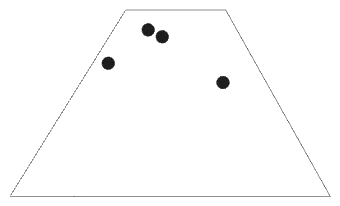
The dynamics would consist of the inertial motion of each of the rolling balls, each described by a
The kinetic terms
Likewise we can merge all of the collisions into a single term:
The full energy function is then:
It now looks we have a single object whose inertia is described by
Surfaces
If instead the surface was uneven or sloped surface, then we’d have to account for the surface with a second potential term, an interaction between the balls and the surface:
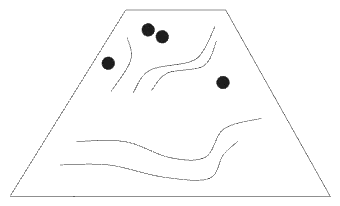
A full solution for the trajectory of the balls would have to incorporate both effects, as well as the interplay of the two: perhaps a ball rolls, then collides and changes course; now it is rolling in a new direction and will experience the effects of the surface differently than if it hadn’t collided.
But there is nothing about the rolling on the hills and valleys of a “surface” that truly distinguishes it from “inertial motion”. We can freely consider consider
Assuming perfect mathematical accuracy, the dynamics given by this rewritten energy function will be exactly the same as when we treated the surface as an interaction. The math cannot tell what is “inertia” and what is an “interaction”—everything in the sum going into
(The basic gesture of Einstein’s theory of gravity is exactly the one here: treating gravity not as an interaction but as inertial motion on a curved surface.)
Internal Motion
Let us now imagine launching our bunch of billiard balls, into space perhaps. It will be easier to imagine if we take away the surface and attach the balls together with strings or springs instead, so we can visualize them flying as a group:

The energy function is:
Another way of writing this is to separate out the “external” motion of the cluster—the motion of its center of mass, along with its orientation and any overall shearing—from the “internal” or “relative” motion of the individual balls with respect to each other:
Imagine this cluster collides with a wall. If this collision compresses the internal springs, on net, then cluster will be launched from the wall. On the other if the springs affected by the collision happen to already be lengthened—perhaps they have been left oscillating by an earlier impact—and are depressed back to neutrality by the collision, then cluster might barely bounce away at all or could even stop entirely.
The third term must somehow contain this “springiness”, which then affects the external dynamics of the cluster via the second term.
Memory
It is obvious that we should be able to predict what a cluster of springs—or a ball itself, bound together by atomic bonds—will do without accounting for every single internal spring or bond. We should be able to replace the second and third terms by a simple “elasticity”:
The move here is generally to “solve” first for the trajectories of the internal variables, in terms of the external, and then plug these trajectories back into
The simplest form of this solution leads to an “elasticity” as just described. This is a great description of a billiard ball up until the point where we need to deal with the squishiness of the ball very precisely, or if we hit one so hard it blows up.
We just noted, though, that the exact reaction of a cluster of springs to a collision can depend in some way on the exact state of its strings at the time of a collision. This means, say, it underwent in a row, the later collisions’ effect would be affected by the fact of the earlier collision. Evidently such cluster of balls, viewed as a whole, possesses a rudimentary “memory”—how it interacts depends on what has happened in its past.
We can rewrite the energy function emphasize the “memory” phenomenon instead:
Here
For very complicated systems such as living things or computers, the memory terms would be extremely complicated and impossible to actually write down: the internal structure is incredibly complex and stable, such that causes can have very particular effects at much later times. I remember things that happened to me 30 years ago—not perfectly, but well enough to describe and perhaps to anticipate in the world. My DNA, furthermore, contains “memory” of things which happened billions of years ago, and has some corresponding effect on the external dynamics of the object which is me. A structure as stable and self-replicating as DNA, or a hard drive, can preserve memory-information for essentially an arbitrary time, so long as it can expend energy to power the self replication process, as energy is required to overcome the entropic tendency for information to decohere into noise over time.
Distinctions
Earlier we merged an interaction term
Why not go further? There is nothing to stop us from viewing even inter-ball interactions like
An “inertial” solution to this problem will be exactly equivalent to a full solution of the original problem. Arguably this is all it means to come up with a “solution” for some scenario of physics: working out the new inertial motion in the presence of some interactions. In this view all physics ultimately reduces to straight-line, inertial motion—the entire universe is evolving forward in the only way it can.
Yet this seems too reductive. Surely not all motion is inertial—not for any useful definition of the word “inertial”. Surely the universe really is composed of “distinct things” interacting with each other, so long as we define a “distinct thing” appropriately.
What makes an object like a ball a “distinct thing”, then, in spite of its being composed of innumerable atoms?
The clearest answer, to me, is from information theory: so long as the ball remains in-tact, the motions of its atoms will be extremely closely-correlated with each other, and the trajectory of any atom in the ball can be described to great precision just by its location with respect to the ball and by the ball’s location and orientation. This description will continue to work so long as the ball is not put under so much pressure it collapses or explodes. This mental or mathematical operation, by which we reduce a whole ball to its center-of-mass inertial motion, therefore discards only a minimal amount of predictive power about the trajectories of its atoms, while discarding nearly all of the fine-grained information about the atoms. If we can do this without losing much, it’s a distinct object.
The notion of “distinct thing” we get here is not universal, but is relative to a choice of time-scale, length-scale, and conditions. This is fine: we don’t feel it necessary to consider each billiard ball when describing the motion of the earth, or each bacterium on our own skin, nor is it useful to imagine what would happen to a billiard ball after being shot into the sun. As human beings, we are mostly concerned with things on the scales of our own lives. An object is distinct to us if we can understand it by such a compressed representation.
The point here has only been to sure up the description of physics in terms of
If we can so easily think of a joint system as a single system evolving inertially, we should also remember the way back home, to the mindset where two balls are genuinely separate objects, and where their collision represents a genuine interaction—a point of contact with something other than themselves.
In fact, when we choose to describe a system
we should always understand this as being part of a universe
And we are really dividing the universe into three parts:
itself, which we have chosen to regard as a distinct thing - The part of the universe which interacts with
, which we might denote by . - The rest of the universe,
.
The overall energy function of the universe has only inertial terms:
When we describe
Rewriting
Thus the choice to describe a system by
is the act of distinguishing this system from the rest of the universe—it is the way back home. And it is a good description if, and so long as, the dynamics can be accurately predicted from
I have been careful to limit the present discussion to “inertial” motion, and have said nothing of “determinism”. All our descriptions—any combinations of
But the universe is not purely inertial; interactions genuinely exist; memory exists; distinctness is real; everything is not one thing, especially when viewed from our own perspective within the universe, as opposed to a hypothetical god’s-eye-view. To believe otherwise is to take the mathematics much too literally.
And if we are to take that god’s-eye-view—the view of mathematics—we have to transform the concept of a “distinct thing” appropriately. If we are to model the universe with concepts, we must model ourselves with the same concepts. We see an entity within the universe whose sense of the universe must be described in terms of their own sensory mechanisms and cognitive apparatus; they possess a capacity to distinguish things and discern patterns; the things and patterns they discern are real, they really do possess the properties to which their cognition naturally couples.
Waves and Particles
In practice, problems of physics are attacked by employing specific and judicious redescriptions. Consider, for example, the atoms in a crystal:
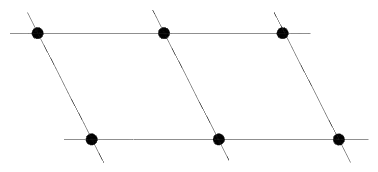
Each atom can vibrate in place. As it does so, it will transmit forces through its bonds with its neighbors, causing them to vibrate also; vibrations therefore propagate through the crystal. Such a travelling vibration is a “sound wave” which, it turns out, can only be created or destroyed in discrete units—discrete “particles” which we call a “phonon”.
This is a basic example of “wave-particle duality”, a concept which is otherwise quite mystifying. (Phonons of sound are somewhat easier to think about than “photons” of light.)
(Note it is the sound waves and phonons which are dual to each other; not the atoms of the crystal. But the atoms themselves have wave representations as well!)
Such a crystal can be described by an energy function in three equivalent ways. The first describes the positions of each atom in terms of their own inertias
The second describes the propagation of sound waves of different frequencies by a different set of terms like
The third describes the same waves but in terms of the number of particles with that particular frequency. Its terms do not even look explicitly like “kinetic” or “potential” terms, so I’ll just write them like
All three descriptions are correct; each describes the same full system. But they make different “distinctions”—treating different parts of the system as the “natural” subdivision.
The first treats atoms as distinct, and is most natural if you want to measure or predict the position of individual atoms, or perhaps to add or remove atoms. This model will continue to work well even if the crystal explodes—atoms are atoms, after all.
The second treats waves as distinct, and is a good description of how sound waves propagate through the crystal. This view is applicable so long as the wavelengths are longer than the spacing of the atoms, but not as large as the crystal itself.
The third description is best for describing how energy will exchange with the external world—one phonon at a time. This view, like the second, is applicable mainly to an intermediate range of wavelengths, but the phonon description alone gives the correct thermodynamic behavior of the crystal (which is how phonons were discovered).
Internal Representations
We have at this point a whole collection of techniques for redescribing systems. We can distinguish a system from the surrounding universe; we can split it into distinct subsystems; we can merge distinct systems into one combined system.
The latter the case is most interesting: we can then redescribe the combined system in terms of external and internal variables; we can sum up those internal variables as a simple interaction term or as a memory term, or sometime can omit them entirely.
The case of wave-particle duality offers another approach to internal variables: we can choose to redescribe the internal variables in terms of different “atoms” than the original ones, perhaps omitting or approximating as we go. Waves (or their dual particles) supply a particularly simple representation of the response of a solid crystal to most impulses short of anything which would break it apart—these are in some way a “natural” form in which to represent the crystal’s behavior. Other systems should admit other “natural” representations. Usually the symmetries of the object dictate what representations are useful—a crystal is self-similar in space; a wave is as well.
What, say, is the most natural representation of the internal state of a computer? So long as it remains operational, the computer software itself is an excellent description of the system (here I mean the programs along with the OS and all the data in memory.) The software defines the relationship between its inputs and outputs extremely precisely, after all. (Usually these interfaces are electrical, but it might be easier to imagine mechanical actuators and the like.) It should in principle be possible to write an energy function in these terms:
I have written the software as a
In this case the software would supply a particularly good way to write the
What about an AI, in particular? An AI model could be described in terms of “software” as well—model structures and weights and the like. But we can imagine doing even better: an AI, after all, can hold a conversation passably well; something in its “internal representation” must come close to the structure of human language and meanings. It should in principle be possible to represent an AI in terms of semantic concepts:
(Here “external” just refers the interface of the AI model to the software which runs it. We could perhaps think of a robot for a better correspondence to physical motions.)
This idea of an “internal representation” (IR) is central to the outlook I am trying to relate. An IR exists—it is part of the universe. It can be composed of simpler atoms (literal atoms, electrical signals, etc.), but emergent phenomena are real, and, if the IR is a good one, are far better descriptions of the system than the underlying atomic description, at least within the typical operating regime. There is still a considerable amount of freedom in how we characterize the IR: there might be multiple compatible levels of IR (e.g. for a computer: electricity—bits—assembly code—high-level programming languages—abstractions and design patterns—UX elements and behaviors) at work at once; different views can be simultaneously true (wave/particle); the IR might be vaguely specified and effectively non-deterministic at its own level of abstraction (as in the case of AI semantics).
The present subject is closely related to what is called “emergence”, but with a different emphasis. The behaviors expressible in the IR could be termed “emergent phenomena”. But to me it is the IR itself, as the set of composeable atoms, which is of interest.
Human Nature
Now we will approach the subject of a human being.
First a brief question: is the time-evolution of a human being deterministic? Can it be described by physics? Can we model it? Certainly the simplest viruses and single-celled organisms are deterministic—certainly a nematode or worm is—an insect?—a mouse?—an ape? If a human is not, where should we draw the line, and on what grounds?
Better we assume the human being, too, to be governed by laws of physics, and figure out how to cope with it later.
Then the dynamics of a human being can be described by an energy function with two terms: a term for the inertial motion of its constituent atoms, and a term for interactions with the external world.
This is technically correct, but says nothing useful. We can, first, rewrite this to distinguish external and internal motions:
The “external” term includes the three-dimensional center-of-mass motion and any motion of limbs, vocal chords, and the like—anything which could be measured from the outside. “Internal” contains everything else.
This description, too, says nothing useful.
Well, a human being obviously exhibits a tremendous amount of “memory”—our interactions with the world lead to internal state changes which affect how we repond to future interactions. Every biological mechanism is an example: genetics, epigenetics, protein concentrations, neurological signals, hormones, neurotransmitters, immune responses, gut flora, metabolization of food… not to mention literal “memory” itself.
We try rewriting the internal dynamics as a memory term:
The memory term describes every single thing we “do” which is in some way generated from our internal state: walking, grasping, speaking… Note that such a “memory” term involves the same external variables as the “external” term, but represents their internally-generated impulses and responses, at a time delay to the causes. An earlier experience with a person might induce me to carry a grievance; that grievance then leads me later to throw a punch, which would continue by its own inertia. The impetus of the punch arises within my “memory” term, while the followthrough is an external inertial motion.
We are still squarely within the realm of determinism. But we are not longer allowing ourselves to directly describe the determinism of the internal variables of the human being. These variables are not undetectable—some internal structure, e.g., would be revealed by an X-ray or MRI, or by surgery or a series bodily injury; other internal states are revealed by our words and actions. Furthermore we can predict internal states by patterns: we know that every human has basically the same biology, which is by now extremely well-understood, and even if we knew nothing of our nature we could predict much just from the patterns of our lives: circadian rhythms, predictable appetites, etc.; of course much of what we know about human biology is the accumulated understanding of these patterns.
Yet the sense of determinism, with its connotation of meaningless mathematical inevitably, seems already to be altered. When we preferentially “distinguish”—draw a distinction around—a human being, such that we speak only of its externally-measurable variables, the equations transform into a form which veils the internal dynamics, and reintroduces a slight element of… mystery? To my eye, anyway. The internal dynamics of the human being are theirs alone, and can only be known from the outside in part, by the channels available to us: by their actions and words, above all, as well as by medical scans and physical dissection, or by correlation with other humans.
At this point, though, our
Well, we have the power to draw distinctions; let us draw some more.
Internal Dynamics
We could decompose the memory term into distinct biological terms:
There will also be interaction terms between every set of variables, e.g. a term for the effect of DNA on hormones might include, among other things, any variability in how certain hormone proteins are synthesized in response to a stimuli:
As usual we have a considerable amount of freedom in how we choose the internal variables. A “good” description of a physical system, recall, is usually one where the inter-variable interactions are small, or, if they aren’t, at least factor cleanly. (The wave model of phonons is a good description specifically because there are nearly zero interactions between waves at different frequencies.)
Now: is the decomposition into biological terms a good description of the dynamics of human nature?
It depends on what you’re doing. The description in biological terms is, I think, a good description if your aims are reductive—if you wish to break the human into parts and to understand the parts individually, i.e., biologically.
We would prefer an extremely fine-grained description if we want to understand the dynamics of a single neurotransmitter, e.g. dopamine. We ought to arrange our description of human nature to isolate dopamine levels as a particular dynamical variable (or even more granularly, the dopamine levels at different locations in the body). We will then find an interaction terms like
On the other hand we might prefer a very coarse-grained description if we aim to understand human nature only in broad strokes and in aggregate—in terms of personality types or mental disorders, say. Variables like “depression” or “ADHD” could be an effective summary of a great deal of low-level dynamics—rather like the solid/liquid/gas phases of matter.
Whether a description is appropriate also depends how you’re measuring or affecting the system. Variables in a physical theory always come in “conjugate” pairs: to fix a volume you have to apply a pressure, to measure pressure you have to allow the volume to change; likewise for heat energy vs. temperature, current vs. voltage.
So the right description depends on what we are trying to do. What are we trying to do, then?
I am seeking to understand morality. I wish to know what one ought to do with oneself, how one ought to treat others, and how one ought to expect and demand to be treated. I would also like to find out how to cope with the apparent assault of determinism on the notion of free will, and, relatedly, to know what a person may be blamed or held responsible for, and when and to what extent force is warranted.
There is natural description for this problem: the subjective view—human nature as seen from human nature. We understand each other in terms of emotions, personalities, memories, idea, habits, and the like—we, subjectively, are the measuring instruments, and the features of our own subjectivity couple to those of others’. We furthermore understand ourselves in terms of these subjective “variables”, and when we act, we perceive our actions as arising from within us by some combination of these causes. And morality itself exists within the subjective: we are the judges of what is moral, as well as the objects towards which moral judgment is directed and upon which it realizes its effects
We should therefore render our model in subjective terms. Internal physical variables like “hormones” and “neurons” should certainly not appear—these are constituents, to a degree, of “emotions” and “memories”, and to include both would be redundant. Nor should “disorders” like depression or ADHD—these are too coarse-grained; they are summaries from a diagnostic view, but, subjectively, are composed of many specific emotions and ideas.
So we can write something like:
(We can keep any non-subjective terms we like, such as one’s diet, physical or mental illnesses, traumas, etc.)
Note the logical move at work here. We have re-rendered our biological view as a subjective one. We are describing the same system, but in a different “language” and different “variables”.
This move is analogous to the treatment of waves in a crystal. The state of individual neurons is analogous to that of the individual atoms, the collective excitations of neurons are analogous to waves, but a subjective phenomena like an “emotion” or an “idea” is analogous to a particle, which acts as an atom again, but within the emergent phenomena of the system.
It is not the case that one view or the other—biological or subjective—is primary or is more true. It is not the case that emotions are “actually” just neurotransmitters and hormones, as one might believe when first learning of these things. Emotions admit a re-description in terms of these biological phenomena, but they are no more “actually” those things than vice versa. These are “dual” descriptions, in exactly the sense of “wave-particle duality”.
An even closer comparison may be made to a computer, whose internal dynamics are best described in terms of the programs it runs, with the variables within the running programs as the natural coordinates for its internal state.
And of course AI provides an even closer comparison. Here the internal state could be described in terms of the values of variables, like a computer—the network weights themselves. But an AI also admits a description in a much-condensed “internal representation”, which can be put into correspondence with concepts in our own subjective representation well enough that we can hold a conversation with it.
But, having written down a theory with terms for emotions and the like, I suspect I have not gone far enough. I could perhaps try to describe a dynamical theory of emotions—how one person’s pride begets another’s shame; how one’s entitlement arouses another’s anger—perhaps a fruitful approach to the two-body-problem—but my sense is that this view will not be get close to the center of human nature itself.
Let us omit the particular variables and simply write
for now. Having justified the move to “subjective variables”, we can now choose for the variables of our theory whatever we like.
We can now begin the project again, working in terms more fitting for a description of human nature. But this will have to wait for another essay.
Outro
What I have tried to convey here is the proper sense of physics, and of a universe modeled by physics. The informal equations help to make precise what can otherwise be vague and disorganized.
The next step is to apply this framework to human nature. Broadly speaking, we can organize the problem by the number of humans under discussion:
- The “One-body Problem” of individual psychology. Along the way, we can try to speak of the phenomena of “free will”.
- The “Two-body Problem” of two interacting human natures, covering romantic relationships, teammates, or anonymous strangers.
- The “N-body Problem” of groups up to “Dunbar’s Number” in size, 150 or so.
- The “Many-body Problem” of large populations like a nation. The model of wave-particle duality in a crystal will be a useful reference point.
Importantly, it will turn out to be useful to analyze the Many-body Problem by treating the large collective as one, two, or N entities; e.g. in terms of a single body-politic, of two competing factions, or as a village of interacting agents all with knowledge of each other.
My eventual aim will be to discern where “morality” appears, and to see what kind of thing it is, without having to imagine it as some mystical thing, dualistically separate from the deterministic universe. My belief is the apparent incompatability of the two will turn out to be a tremendous misunderstanding (of physics, mainly).