The Planes
- (This post)
Much has been said, and it is all very confusing. Let us bring it all into the same view, such that we may make some sense of it.
Table of Contents
The Real and the Subjective
There exists a real world outside of us: the “real plane”. There is no reason to believe otherwise. The real plane is, as far as we know, deterministic, or at least adheres strictly to physical laws even if these laws are less than fully deterministic.
We, of course, have only sensory experiences of the real plane: vision, hearing, touch, taste, and smell of course; also the sympathy of our bodies for other bodies; also interoception: hunger and pain and the like, as well as the experience of our own thoughts and feelings arising within us. These senses and experiences together comprise what I will call the “subjective plane”.
Our experiences on the subjective plane are not reality, but are closely related to it. And subjective experiences are real, in a certain sense: we exist within the real, as bodies—so there exists bodies sensing and feeling whatever it is we sense and feel. Of course you and I sense and feel different things, but our experiences are similar—both arise by the same sorts of sensory faculties; both arise in response to the same world, seen from almost the same place; the world itself contains a great degree of stable and predictable structure. Our two experiences, then, contain a good amount of true information about the same, shared reality.
Yet subjective experience is a certain projection of that reality, which has been filtered, translated, or transformed in some way. The two are not identical. Given enough time and attention, the subjective plane can converge to an accurate representation of reality, up to the limits of our sensory faculties and cognitive processing, and insomuch as reality remains stable and predictable. This will be a general pattern: each of our planes will contain a measure of information about the previous ones.
The Moral
Now: while the subjective plane in principle contains the sum total of sensory experience, it is clear we do not directly experience all our sensory inputs all of the time, nor could we. Instead our sense-data is filtered through a sort of learned “model” of salience: of what-is-relevant, pertinent, surprising, theatening, or deserving-of or requiring our respect or attention. This model is felt subjectively to be moral, not in the sense of “ethical” but in that it is felt to operate in terms of moral valences—good and bad, virtuous and evil, powerful and weak, dangerous and safe, respectable and crude, etc. The subjective plane, when experienced through this moralizing lens, produces what I will call the “moral plane”.
The primary aim of this framework is to see the moral plane clearly and in its proper context. I will develop the moral plane at length elsewhere, so I will say just a bit about it now to give a sense of it:
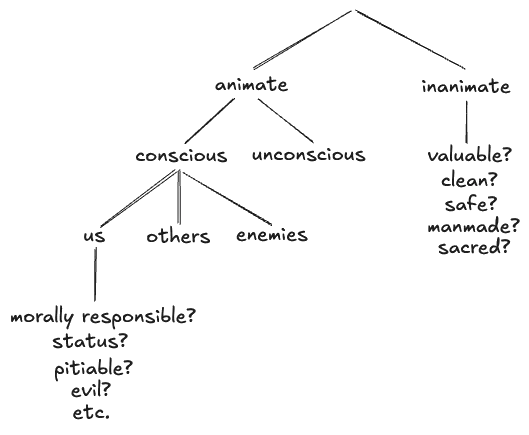
The most basic distinction on the moral plane is “animate” vs. “inanimate”. Within “animate” is “conscious” vs. “unconscious”, with “unconscious” not really a binary distinction but more an admixture with a high proportion of “inanimate”. Within “inanimate” are such distinctions as “valuable” vs. “not valuable”, “clean” vs. “unclean”, “safe” vs. “dangerous”, “natural” vs. “artificial”, and “sacred” vs. “profane”. These are not binaries, but rather are qualities which a thing or place can have in degrees. Note that these distinctions clearly act as heuristics which we use to navigate the world—e.g. we treat “unclean” things in a certain way. This is the primary function of the moral plane.
Note that many of these moral distinctions are not obviously “moral”. They seem like simply properties of the thing! An unclean bathroom, say, is just… dirty. But the moral property “unclean” does more than describe the thing—it implies appropriate behavior in people who interact with the thing. We know to avoid unclean surfaces, and to wash ourselves afterwards if we come into contact with the uncleanliness; we would judge a person who caused a place to become unclean, or who has failed in their duty to clean something, or who has failed to purify themselves after contact with something unclean.
Within “conscious” is a distinction between “us”, “enemies”, and “others”. These too can be mixed to various degrees, and “us”-ness can be combined along different identitarian lines: by ethnicity, nationality, age, political tribe, subculture, etc. “Others” are generally those we do not expect to align with the values of “us”, while “enemies” hate us and are actively opposed to our values.
Again these moral statuses imply behaviors: we trust “us” naturally, we exercise some caution around “others”, and we put our guard up immediately around “enemies”. This distinction also modulates how we react if they offend us, or how receptive we are to being told we offended them, and much more besides.
Within “us” is quite a bit of structure, involving such characteristics as moral responsibility (which we expect adults to have, and children not to) agency, status, power, deservingness-of-pity (which we normally reserve for legitimate misfortunes), etc., as well as the values and ideals of our particular in-group.
Many of these same qualities are involved in distinguishing “us” from “others”. “Us”-ness is a sort of gradient, and the instinctual response to out-of-line behavior by one of “us” is to stigmatize them, threatening to banish them to “others” or “enemies” unless they correct course.
Also within “us” is found the moral status of “evil”, which is reserved for those who are of “us” but who are unresponsive to, or too powerful to attack with, the stigmatization process.1 We feel that the evil person’s will ought to be broken by punishment or force. To be “evil” is therefore different than being an “enemy”, but two factions within “us” which view each other as evil might wind up becoming enemies if their mutual stigmatizations escalate for long enough.
In summary:
You can probe your own moral plane by bringing to mind any thing and examining the feelings, judgments, and associations which arise in you in response. Try these: glasses, cowboy boots, marijuana, classical music, Haiti. Likely multiple moralized feelings and beliefs arise at once. Likely they have changed throughout your life—the old ones might still be there, but have been suppressed or rejected.
All of this is an oversimplification, but should suffice to give a sense of the moral plane.
The Emotional
So far we have visited three planes:

What should come next?
When we encounter any stimuli which elicits a reaction from us—an object, a person, an idea, etc.—our reaction is really determined by our moral beliefs about the thing. These reactions are feelings, we just said—emotions. Sometimes they are rapid and intense, as when encountering a threat; sometimes they are nuanced or nearly invisible.
These emotional reactions, large or small, comprise our next plane: the “emotional plane”.
To clarify the sense of this plane, consider the reaction you might have to an erratic driver on the road: your attention is pulled into the present by an alert sort of fear—you lock in. Or when humiliated in a group: shame forces your attention inward to attend to your own moral status. Evidently emotions govern our moment-to-moment attention. This holds in the long-term as well: an anxiety, e.g. concerning money or a political issue, will continually recirculate awareness of its subject into your mind—keeping it from falling out of your attention for too long.
The emotional plane, then, defines our awareness. It is an attention-filtered view of subjective experience, along with all the memories, ideas, and fears which circulate through our conscious minds.
The other important function of emotion is to convey our internal state to the people around us. Anger imparts a stigma, affecting others’ actions and beliefs; embarrassment induces others to avert attention from us, sadness solicits care, self-pity solicits something like mercy or forgiveness, etc. An anxiety, also, will usually compel us to talk about the thing frequently as well, circulating it those around us. The faculty of empathy renders us porous to the emotions of others, as well—at least to the extent they share some “us”-ness with us; some status or standing on our moral plane. So we cannot help but participating in some part in others’ emotional experiences, and they in ours. Our emotional planes all run together. We are made aware of each other’s moral beliefs as well as our own.
The Rational
The next plane is the “rational plane”—the plane of rational concepts and arguments. My conception of the rational borrows heavily from the book The Righteous Mind: rational arguments are best seen as rationalizations of underlying and prior intuitions, emotions, or beliefs. In my framework these prior beliefs belong to the moral plane; we then have emotional reactions to moralized ideas, and rational arguments emerge out of our attempts to convey and justify these emotions and the underlying moral beliefs. The rational plane itself, then, is the body of concepts and arguments by which we understand and justify our moral beliefs.
For example: that moldy food is “unclean” is a moral belief. When moldy food repels us that is an emotional reaction. Then our understanding of the nature of mold, its causes, and the harms it can cause comprise the rational understanding. Note that we surely have an instinctual aversion to moldy food. This I do not consider a problem with my framework—moral beliefs can be instinctual or hard-coded as well as learned. The rational follows the moral in either case: before we had a biological understanding of mold, people would have had some other rational concept of what it was and where it came from; our understanding may be more “true”, but both are rational.
The ideas which belong to the rational plane belong to a certain “rational faculty” in the mind—a truth-seeking impulse, which is averse to contradictions and inconsistencies. This is unlike the moral plane, where contradictions are commonplace; I think it is the case that the rational faculty comes into play specifically when we try to untangle the contradictions in moral beliefs and arrive at verdicts or policies.
The rational plane therefore has a sense of “refining” the moral. As babies we express ourselves through unrefined outbursts of emotion. Then as we age and acquire language, we become able to communicate specific and nuanced needs and desires. The mere expression of emotion ceases to be necessary, and in adults is considered inappropriate when words will do. Once equipped with a vocabulary of abstract ideas we become capable of something like “purely rational” thinking and communication, but even then I tend to think we are still only “refining” the emotional impulses of a child; emotion, per the Righteous Mind thesis, is fundamental.
The rational plane is really characterized by this faculty, it is by no means a requirement that an idea on the rational plane seem rational to us, or is “true”. People will rationalize our of whatever materials are at hand—spiritual or supernatural principles will do as readily as logical or philosophical ones. Before the Scientific Revolution, many a rational argument would have been put forth on a basis of theology or Aristotelian physics, or simply common sense. The grounding of truth in empirical knowledge and well-tested theory arrived only relatively late in history. (It was the many contradictions of those pre-Enlightenment philosophies which pushed empirical truth to the fore—the same “refining” of contradictions describes the story of intellectual progress as a whole.)
Even today, I can refer in an argument to, say, the U.S. Constitution, which will strengthen my point so long as my interlocutors believe I have made the reference faithfully and hold the Constitution itself in good standing. In doing so I would be drawing upon the credibility of that document, just as a Renaissance intellectual would draw upon the credibility of Aristotle.
This sort of “web of trust” is typical of discourse on the rational plane. It is about right to think of the entire rational plane as an enormous edifice built of trust, perhaps rooted ultimately on our innate faculty for pattern recognition, by which we can become convinced of the truth of things at an emotional level.
(That the proper approach to interpreting the Constitution is constantly up for debate is evidence of the fact that rational argument arise out of attempts to rationalize our own moral beliefs. The evidence comes later: rarely do we start from the evidence and work out the implications in a forward direction.)
The Logical and the True
So far:

We are nearly finished with our tour. I have seven planes in mind—a number which has always enjoyed a degree of significance on the moral plane. We will visit the last two only briefly.
Next is the “logical plane”. We arrive here by isolating, within the rational plane, the inferences, patterns, and abstractions which develop by valid logical argument within the mind. Mathematical knowledge lives here, as does empirical truth and practical knowledge which we arrive at by sound reasoning from patterns in the world.
In distilling a logical truth from a rational idea, we seem to be discerning something which would still be “true” even if we had not recognized it. Mathematics, after all, follows logically from its own principles, and empirical knowledge is, or at least has a good claim to being, a true description of reality.
We can therefore complete our cosmology with a very simple final plane: the “plane of the true”, or simply “the truth”—a meta-physical realm of all true knowledge and of the forms of all things.
Our logical faculties can only ever glimpse the truth—the logical plane is a kind of instantiation of the true within the human mind. (This is appealingly similar to the relationship of the subjective plane to reality.)
The logical and the true planes are the home of many fascinating things (all of math, for one). But they are not, to me, all that interesting in themselves, so I will say nothing more about them.
In all:

Each plane, except the “real” and the “truth”, refers to a certain layer of the human experience—literally, a cognitive function, which is layered onto the raw experience of reality. To emphasize this sense of layers we might draw the planes literally as “planes”:
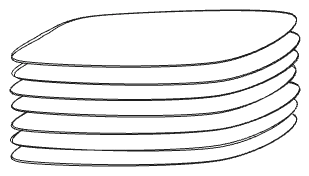
Or a bit more vividly, we can depict the plane of reality as extending far beyond our own localized subjective planes, while we all aspire to access the same universal truth:
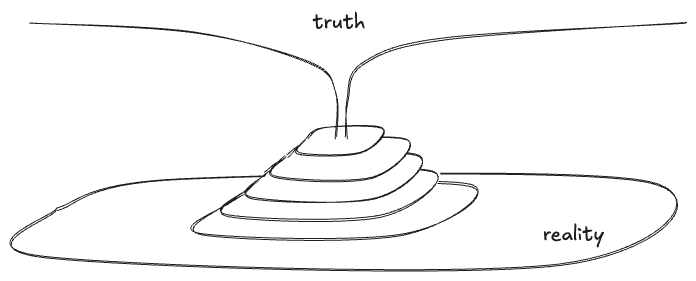
These diagrams might seem to imply that each plane bears the same relationship to its neighbors as all the others, but this is not the case; each relationship is quite specific. What we may say in general is that each plane, working in from the “real”, carries information about the previous: the subjective is a view of reality, the moral is a model of the subjective, the emotional a narrowed view of the moral, etc.
Information also conveys in the other direction: the logical is a glimpse of the true, the rational applies the inferences of the logical, the emotional reacts to the implications of the rational, the moral model updates in response to emotions, and the subjective is modulated by the moral.
And the ultimate function of this arrangement is to govern our actions in the world: we experience the world, we observe and learn, we build a model of reality and strive for truth, and then, in response to the desires which arise in us, we act on reality. We live and we learn, and then we live some more.
A sense of the human experience emerges. Our lives occur at the interface between two unlike influences, two forces: reality and truth—what is and what is entailed.
I find this system of planes to be extremely clarifying. A great many ideas and phenomena can be mapped onto it. Many have already come up. I will also mention “mystical experiences”—these seem to have something to do with the direct experience of the subjective or even the real, without its normal mediation by the moral, emotional, and rational. That “the Tao that can be spoken of is not the eternal Tao” comes to mind—the real simply is, and does not belong to any of the planes of our mind; rather our minds belong to it.
At the far end, mathematical “insights” act something like the “direct experience of truth”—a mystical experience of another kind. Yet it is interesting that mathematical truth, in this framework, is in a sense directly opposed to reality—reality may be described by math but isn’t math, it is completely different in kind. To my eye the sort of existential anxieties which often arise at the notion of a deterministic, mathematical universe are really the consequence of mistaking the true for the real—and of losing contact with the sense of the real at all.
I have quite a bit more to say about the planes, and about the moral plane in particular. Three themes are prominent in my thinking:
- The common error of mistaking one plane for another; in particular, the failure to recognize the moral plane for what it is. Often, I suspect, we do this on purpose.
- The disordered state of the human mind, in which one’s moral beliefs cannot change at all. Where does it come from? How can one escape it? How should we treat others who are trapped in this state?
- The phenomenon of “pride”, which I see as a certain kind of moral belief about oneself, not exactly with a “positive” valence, but more of a “false negative”—that some error has been made in one’s not being well-regarded on others’ moral planes. Pride is instrumental to the learning process, but at the same time tends to lead to the disordered state of mind, and so is destructive. Yet it is extremely subtle and difficult to detect in oneself—we will have to describe it extremely clearly to bring it into view.
But a great deal has been said already. These will have to wait for future essays.
-
A common feature of modern politics: we often believe some other people belong to an “us” with ourselves—we’re all Americans, say—but that they have chosen to be unresponsive to moral stigma and therefore are evil. Meanwhhile the people in question do not consider themselves to belong to the same “us”, or have a completely different idea of the defining values of that “us” from our own, such that we’re the ones who are evil. This leads to a lot of unnecessary strife. “Us”-ness in a large population does not really work the way the human mind expects, and it would best to think of almost all strangers as “others” rather than “us”. If an “other” offends you, you would never stigmatize them—you would push them away or avoid them. The undue assignment of “us”-ness, in excess of ongoing firsthand experience with the other, turns out to be extremely harmful. We are not all one! To imagine we are is asking for trouble. ↩