The Gods Theoretically
- The Gods I: The Gods as Phenomena
- (This post)
I do not doubt that the ancients did an admirable job of understanding the world with the tools available to them. But if all you have is the idea of an animate being, everything is going to look like an animate being. Let us try to understand the gods… differently.
A moment ago we came by the notion that the gods might act in the manner of natural law, like the force of gravity. Let us see where this thought takes us.
Suppose the “force” of a god acts on me. Perhaps a few god-forces act on me at once.
Here I am imagining the scenario from the previous post: a stranger on the street accosts me. The Ares-feeling encourages me to lash out, while the Apollo-feeling urges me to remain aloof and not to do anything out of line. Zeus, sovereign to both, judges the stranger as in the wrong, but instructs me not to take matters into my own hands.
Could we depict this with a force diagram, as in physics?
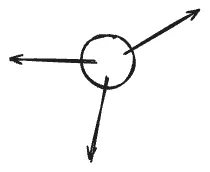
No “equal and opposite reaction” is implied. Nor is “Newton’s Second Law”—the example just given indicates how the resulting action under the influence of multiple gods is nothing like the “sum” of the individuals. Instead the sovereign relationship of Zeus to the other gods wins out (we might call this Zeus’s Law).
A number of the god-forces pertain to bonds between people: the Aphrodite-force forms pair bonds, the Hera-force maintains them. The bonds of a molecule come to mind:

The Zeus-force and Apollo-force maintain the bonds within collectives or social structures—like solid matter?
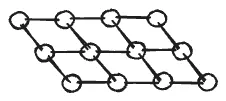
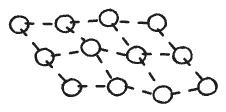
Then Dionysus might be said to soften the collective bonds into a viscous or liquid state, allowing it to flow under the influence of other forces rather than build up pressure.
These exercises are a little clarifying. The phenomena described are obviously real: much of what we do is under the influence of emotional forces like these, rather than our own “will” per se. Often these forces originate in the emotions of other people, but are not entirely subject to their wills either. We can chase the causal chain further… it seems to have no end. These phenomena seem to propagate through the social fabric without beginning in any particular place.
When we begin to try to carry these observations across the bridges supplied by analogies twithphysics, we begin to find some language for it. These phenomena belong not to individuals but to the social fabric itself.
Analogies to physics have a way of setting loose a swarm of related concepts (rather like opening Pandora’s box). From among this swarm we can pick out a few more suggestive ideas.
Probably the three most ubiquitous sorts of physical systems are particles, waves, and fields.
Of the gods described so far seem to function, Ares and Athena seem to act like particles. The Ares-force we can see as being mediated by a kind of “particle of retribution” which bounces back and forth, energizing both sides of a dispute until it either annihilates one or the other (as at Troy), or sends the two flying apart. Ares then plays the part of a “propagator” by which that particle of violence remains in motion, as if under its own momentum.
In the Athena-force we can see “particles of ideas” emitting from one mind and absorbing in another, sometimes to merge with other ideas, or to re-emit again.
Apollo and Dionysus we might loosely render as waves: as collective motions of the social fabric, contracting or expanding its bonds in response to the external level of risk. Generally we relax when we are around relaxed people and grow tense around tense people; in this way relaxation and tension propagate through a society.
(We will not try to make a literal analogy to wave-particle duality.)
Rather than think of the god-forces as being found in the direct interactions between people, we may think of each person as interacting with an ambient field. The prototypical analog is the gravitational field which mediates the gravitational attraction of matter.
The idea here is not of a field “all around us”, extant in spatial reality, but rather within the medium of our minds and emotions, which are all linked to one another by our capacity to model other minds, to mirror other bodies, and to remember experiences.
So we might think of a Zeus-field, the Apollo-field, etc. each mediating the respective force.
As usual Covid quarantine practices provide a vidid example of the Apollonian force. Suppose I am induced to quarantine when I perceive all my friends as doing so. In one sense we can see this as particles of Apolonnian rigidity propagating from them to me, or as waves. At the same time I re-emit the same force back at them, strengthening the feeling in them. At the same time I am reacting not only to their rigidity but to evidence it represents as to the consensus of a whole culture—a whole city, or at least my slice of it, etc. Individual interactions acquire greater weight than they apparently deserve because they stand for the whole community.
Similarly we tend to respect the law and the various pieties of normal health and safety, of etiquette, etc., without actively being told or forced to do so. We interact only rarely with actual enforcers of norms. Usually we are interacting with an ambient shared understanding of those norms, reinforced at times by the reactions of whoever happens to be around us. This is the sense of the “field” of a god-force.
I will not attempt to say what exactly corresponds to a “god” itself in this analogy. A “field”, in the sense of physics, can be the home of a variety of phenomena at once: particles and waves (like photons or light waves) but also, depending on the properties of the field, other exotic emergent phenomena: knots, vortexes, traveling “fault lines”, or collective motions of whole “structures” within the medium—various “emergent phenomena”.
At some level every physical phenomenon we know of “emerges” out of elementary fields: plants, animals, computers, consciousness… so it is not inconceivable than some kind of “consciousness” could be defined within the god-fields so described. But I would consider this unlikely. I suspect that the reason ancient people took to calling these natural forces gods was so that they may be subject to the essentially-human process of attributing blame or credit. If we cannot blame the gods, then when we are hurt by their forces we will always look for a human to hold responsible; being able to cast blame onto the gods, or to fate itself, lets the particle of blame exit the human medium entirely.
This line of thinking is, of course, extremely vague. But it is interesting to note that this human-interaction field is a real thing, simply by definition. Obviously its dynamics would be so complicated that concrete claims and predictions would be impossible. Still, I find the field concept useful: in this way we can steer clear of the language of woo-magic or metaphysics. There is room to say quite a lot while still speaking of manifestly-real things, so long as we use a vocabulary up to the task of describing reality.
Along these lines, we may try to describe a phenomenon, appearing in a number of myths and especially in the later Athenian tragedies, wherein some original “sin” introduces a sort of “curse” or wound into the world, which proceed to propagate from one character to another, sowing evil.
Often the instigating event is divine: one of Zeus’s affairs (Io, Europa), the exclusion of Eris from a wedding which kicks off the plot of the Iliad, or a prophecy of misfortune (Laius, Agamemnon); occasionally it is a particularly egregious mortal impiety, as in the case of Tantalus. Once set into motion, the curse will pass around the mortal world, leaving a trail of grief. Each character tries to avoid being the final victim of fate by deflecting the curse onto someone else. Retribution is the typical mechanism; attempts to evade prophecy by committing “necessary evils” are another. The curse always survives. Some kind of law of “conservation of evil” seems to be required by fate.
Such a curse, having been introduced into the world by divine means, cannot be put to rest by mortals alone. In some tales the evil becomes concentrated in the form of a monster (the minotaur, the hydra) where it can be purged by the hand of a half-divine hero. But even this is not enough to clean up the whole mess, and a stray strand of grief survives, as when Theseus, forgetting to raise the white sails after his victory, causes his father’s suicide.
In other cases the gods must intervene directly: the Iliad ends with an immortal intercession to quell Achilles’ rage; the Oresteia ends with Athena assembling a court of judges and passing the deciding vote herself. One thus gets a sense of a curse as an “antiparticle of divinity” which must in the end be cancelled out by annihilating with a particle of divinity itself. Sans divinity the curse can only be redirected, or “scattered”…
Even when the curse has been purged, the world is altered. A common consequence is the end of a royal bloodline and the birth of a new one. Often a new city or institution is founded: Thebes, Rome, the Oracle at Delphi, or the Areopagus court in Athens, the progenitor in myth of the very concept of justice-as-a-system. The original crime, by way of this sort of karmic “butterfly effect”, does in the end bring about new life…
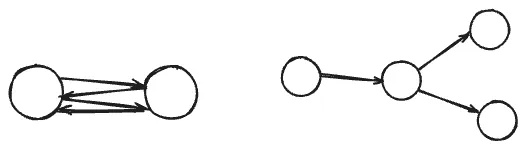
I cannot help but see such stories as describing a kind of metaphysical law by which evil interacts with mortal life. Aware of the absurdity, we may try to draw a “Feynman diagram”, which in its distinct orientations describes different processes in the lifetime of a curse: first the deflection of a “curse particle” at the cost of mortal life, second the annihilation of the curse with a particle of divinity, in the form of a god or hero, bringing new life:
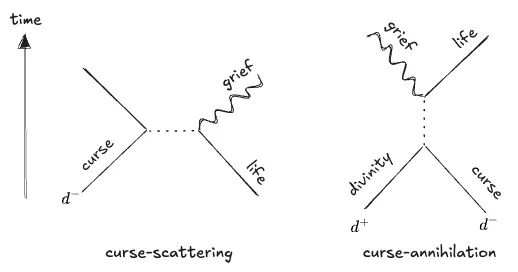
Such diagrams represent a “process” which may be “stamped out” out any number of times in the course of history. Without trying to make the analogy too precise, and without trying to depict how curses originate—perhaps some other process—we can sketch an imaginary “trajectory” of a curse ending lives and sowing grief until it finally annihilates with a source of divinity:
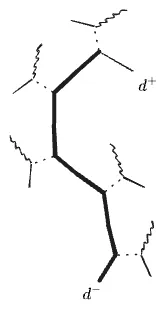
(The curse is in bold.)
This is mostly just a curiosity which lodged itself in my head around the time I first learned about Feynman diagrams. Originally it was conceived more as a model of “generational trauma” and generally of the way evil spreads through the world. But it models the treatment of evil in classical literature remarkably well.
Obviously my examples, coming from literature, may be said to be representative only of a particular narrative understanding of evil, as conceptualized in human minds, rather than of anything in reality. And even then this is only an esoteric and imprecise model of the structure of that literature, with none of the poetry—all bones and no flesh.
Is there any reason to think this model might represent reality at all? Well: one does not have to look far to see that “evil”, for some definition of the word, tends to propagate in reality. We defect from norms when we expect others to defect. We retaliate rather than forgive when we expect retaliation. We abandon ideals of justice when we feel that justice has failed us. Etc. Things of this nature. There must be some dynamic to these processes. And they play out within human nature: it is not out of the question that the human conceptualizations of these dynamics have some resemblance to the real thing, being wrought of the same substance. I will not try to speculate as to what ought to be identified as “divinity”, but we may observe that it ought to belong to this same medium—humans ourselves, not a supernatural or metaphysical plane—and that, whatever it is, it is to be known by its ability to end the propagation of evil rather than merely redirect it.
One more analogy, which is really the germ from which this whole unhinged line of thinking of mine grew.
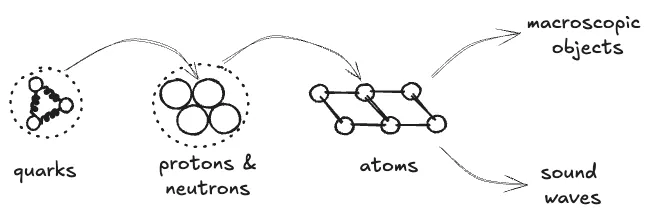
Our most complete physical theory is the Standard Model of particle physics, which primarily describes the dynamics of fundamental particles at the sub-atomic scale. Yet one can readily write down theories which describe, not fundamental particles themselves, but various “composites” thereof. Such theories can be perfectly suitable for making accurate predictions so long as the energies involved are not so large that the underlying internal structure starts to show itself. These are called effective theories in physics, because they are, well, “effective”, despite ignoring much of the underlying dynamics.
For example: protons and neutrons are composed of quarks, but an effective theory which ignores this internal structure, treating them as indivisible particles, works fairly well. Similarly an alpha particle—two protons and two neutrons—may be treated as a single particle with reasonable accuracy. Etc. Classical Newtonian physics can be seen as an extreme case of this procedure, well beyond the point where the underlying quantum mechanics has become irrelevant to the dynamics.
We can also write effective theories for “quasiparticles” which are not really composites of the underlying particle at all. For example, sound waves in a solid object or a fluid are composed, not of specific atoms, but of the collective displacements of all of the atoms of the medium at once. Theories in terms of other abstractions are also possible: vortices, knots, or even “holes”—the absence of a particle acts in many ways like a particle itself. Some examples:
Now, might we then think of a description of nature in terms of gods as an attempt at an “effective theory”? We have seen how the gods seem to be composed of the various faculties and emotions of individual humans. Athena lives somewhere within the medium of human thought: she is, we might say, a particular composite of all of our thoughts. And why is Athena the child, by Zeus, of the titan Metis whose name means “thought”? Might we not say that Athena is a composite of which thought is one constituent part? Thought alone is not wisdom; something else is needed. If Zeus stands for order, we might read this pedigree as a claim that it is the orderedness of the mind which makes her wisdom accessible to us. This is plausibly true. Or we can try a different reading: perhaps it becomes possible to think towards long-term goals when one’s standing within the social order is assured and accepted; perhaps it is the need to assert or defend social status which renders longheaded planning impossible. (Odysseus, after all, is the only fighter in the Iliad who seems to have nothing to prove—thus he is capable of feats of thinking which others are not, and can actually win the war.)
With this framework we can give a concrete meaning to the bizarre genealogy of the deities: each generation is its own effective theory, and the new gods are composites of some kind of those of the preceding generation.
The obscure proto-deities—among them Ananke (necessity), Chronos (time), and Chaos (well, chaos)—play the part of the “fundamental” god-forces at the lowest level of abstraction. These we can read as decomposing, not nature itself, but the human experience of nature: we contend with necessity, we live out our lives in time, we are subject to the whims of chaos, etc.
Out of primordial experience emerge the first gods: Uranus (sky, rain), Gaia (earth), Eros (desire), the Fates, and others. Together these entities seem to subdivide the natural world into constituent elemental forces. Humankind does not yet appear; these forces characterize the experience common to humans and animals alike.
We then come to the generation of titans, ruled by the obviously-agricultural figures Cronus and Rhea, and including also Prometheus, Metis, and Epimetheus (forethought, thought, and afterthought or hindsight). The sense here is of a hazy emergence of human understanding out of animalistic nature, concurrent with, and probably made necessary by, a stable agricultural economy.
Next come the Olympians, in two generations: first Zeus, Hera, Poseidon, Hades, then the many offspring of Zeus already discussed. Out of dim origins in agriculture emerges the domestication of animals, and with it a whole new social paradigm: cattle are currency, and can serve as prizes in war, dowries for brides, tax obligations, ritual offerings, etc. A system of patrilineal chiefdoms emerges and gradually expands into the Bronze Age palace economies seen in myth. This is the civilizing order of Zeus. His offspring then represent the distinct human virtues appearing within that order.
In this view, each generation of deities acts as a distinct “effective theory” which describes the human experience at a particular stage of cultural development.
The structure within a generation represents the approximate relationship between its atoms. That Uranus is to Gaia as a father to a mother is obvious: rain begets life. The exclusion of Hades and Poseidon from Olympus we can perhaps read as a description of human consciousness within the Olympian order: death, scarcity, and natural calamities are no longer things most people contend with directly but are instead experienced through the abstraction of the social order—one fears being punished for failing to meet one’s social obligations rather than fearing death itself.
The events within each generation of gods we may understand as developments within the corresponding socioeconomic paradigm. So Prometheus’s theft of fire acts as an early amendment to the Olympian palace-economy order, a coup by the titans of old to alter the relationship of gods to men. And Hades’ wintertime custody of Persephone represents a compromise between the Olympians and the forces of death and necessity, forces which, after all, cannot truly be made irrelevant to life.
The progression of time in the myths represents, not time itself, but the way these constituent atoms flow into higher levels of abstraction. This, to be clear, happened in time, in the sense that human consciousness co-evolved with the progress of socioeconomic paradigms: hunter-gatherer, primitive-agricultural, etc. But it may also be seen as something instantiated now, in the present, as a tower of abstractions. A later Roman writer, describing the meaning of the myths, wrote: “these things never happened, but always are.” In a strange way we have found this to be true.
It follows that there must have been many more generations of gods since the Bronze Age. Zeus reigned until the Bronze Age Collapse; surely this calamity was a coup in heaven just as on earth. By the time of Classical Greece, someone else was in charge. Athena? Certainly in Athens from which we have inherited so much. During her reign were born gods of writing, mathematics, philosophy, democracy… Soon after came the age of Alexander, who perceived the divine throne to be empty and imagined he could claim it for himself. But Alexander was only the mortal instrument of some unnamed usurper of Olympus, whose order was empire. Rome followed. Then Christianity—we may as well consider the Hebrew God in the same terms, leaving open the question of where it belongs in the hierarchy of theories. In time Christianity would sideline all the pagan deities as demons, imprisoning them just as Zeus once imprisoned the titans. But it seems clear that the god of Christianity was wedded to the god of empire; the two reigned hand in hand for a millennium. Eventually the heavens were set back into motion as the many offspring of that marriage came to maturity: gods of sailing, trade, engineering, music, art, mathematics; of exploration, plunder, plague, white supremacy; of capitalism, empiricism, science, law; of liberty, industry, modernity, finance, medicine…
I was born in the reign of an unnamed god whose order was neoliberal modernity, and whose reign has been largely peaceful. But his or her claim on the heavens is uncertain now—threatened by their marginalized siblings, by their own unruly offspring, and by older deities refusing to die. The god of the computer now comes of age (some distant descendant of Hephaestus or Athena, perhaps?). Who can say what will happen next? Is the art of prophecy still practiced anywhere?
As ever I am only sketching the general shape of a thought. Developing this into something precise would surely be impossible—not that the ancients did any better, with their complicated and often contradictory genealogies of gods. Certainly one should not try to map all the structure of myth into these terms; that path leads to madness. But it is clear that the ancients were trying to describe the relationships between the abstractions visible in their world, in terms of the concepts they had at hand. When their language ran out they filled in the gaps with vague supernatural ideas, as we humans always do, and the result is a cherished body of myths.
Today we have a far richer language for describing natural phenomena. We can take on the same project in our own terms, borrowing only what is self-evident, or useful. In doing so we have the opportunity to tidy up our cultural inheritance somewhat.
One remark before we continue. The conceptual path just taken bears a resemblance to “memetics”, which broadly may be understood as an extensive analogy between the flow of ideas or beliefs on one hand and the flow of genes in evolution on the other.
The gods, understood as physical forces, or as an effective theory of nature, are not memes, despite their “reproducing” in a fashion. We would not designate physical concepts—force, work, torque, etc.—as memes; these might be described by concepts evolving memetically, but the things-themselves are real and measurable. Likewise the genetic code of an organism is composed of genes, and of course it produces the physical organism, but the organism is not identical to its genes. So the gods in the present account are “real”, as opposed to being the information or ideas which describe them.
On closer inspection, the relationship of the gods to ideas is rather complicated. On the one hand, our conceptualization of the gods—whether as myths or, in the present essay, via a deliberate cross-breeding of mythology and physics—is explicitly memetic. The process of ideation then admits a vague description in terms of gods, as the work of Athena, Metis, various muses, etc. Then the product of this idea-generation process feeds back into the emotional plane: we create laws, institutions, and technology in the image of our understanding of things. In this way ideas act on the world. So the memetic-evolution process participates in the dynamics of nature, which itself is describable in terms of ideas…
So what? It will be important, when trying to understand these phenomena which span both our own minds and the world, to maintain the distinction between reality and our description of reality, such that we can change our minds to better bring reality into view. We must see things “in perspective”, so that, by a sort of “parallax” we may deduce the nature of the real thing by adjusting our conception of it. Therefore we must not mistake our theory for a description of ideas, reproducing memetically, or anything like that.
It is surely unclear where I’m headed with all. Well: one must write what one can. I began to speak, and I found I needed to first explain a mountain of concepts just to articulate what I had in mind. The actual thought, when the mind is operating in this “gear”, comes at the end. We can, afterwards, traverse the same ground in reverse to build the argument outward from the motivating thought. For now we must continue on our path.